
The warehouse shift starts on plan, but then something changes.
Picks begin to slip. A few call-outs leave gaps on the floor. Volume comes in heavier than expected, and now your pack team is working through a backlog that isn’t shrinking. By mid-shift, the operation isn’t running the way it was designed to.
That moment used to be a rare exception, but it isn’t anymore.
In a recent SupplyChainBrain webinar with our Rick Faulk, Mike Johnson, and Kait Peterson, moderated by Bob Bowman, the discussion kept coming back to a simple question of what keeps the warehouse floor moving when the plan breaks?
Increasingly, the answer points to a shift in how fulfillment is executed toward Robots-to-Goods (R2G) models that are built to keep work flowing even as conditions change.
What Causes a Warehouse Plan to Break?
Warehouse operations aren’t dealing with one disruption at a time anymore. They’re dealing with several, all at once, and they stack faster than most systems can adjust.
Labor drops mid-shift, and the pick rate falls with it. Volume spikes without warning and packing stations start to back up. SKU counts keep climbing, which stretches pick paths and slows everything down. At the same time, delivery expectations are tighter than ever, so there’s no room to recover once things slip.
Layer in supply chain variability and the occasional external shock, and the plan you started the day with doesn’t last long.
Any one of these issues is manageable, but the problem is when they show up together.
Mike Johnson described a scenario that used to sound extreme — planning for 50,000 units a day, then getting hit with 600,000 overnight. That kind of swing used to be rare, but now it’s something warehouse operators have to be ready for at any time.
When that happens, the plan doesn’t carry the shift. The operation either absorbs it, or it doesn’t.
As Rick Faulk put it during the discussion, “Confidence is not about predicting the future anymore. It’s about building operations that don’t need to.”
Planning Still Matters. It Just Doesn’t Carry the Shift
Planning hasn’t gone away, but its role is different than it used to be.
Forecasts still matter. Labor plans still matter. But once the shift starts, those plans are already under pressure. People call out. Orders change. Volume moves earlier or later than expected. What looked balanced on paper starts to drift.
Operations now have to assume variability as a baseline.
As Kait Peterson explained, the shift is toward designing for resiliency by building operations that can perform even when labor, volume, and order profiles don’t behave as expected.
That’s where the idea of operational confidence becomes more concrete.
Operational confidence is not about having the right plan. It’s about having systems that can keep work flowing when the plan changes and maintain throughput despite variability in labor, volume, and demand.
Where Fixed Automation Starts to Show Its Limits
This is where the distinction between fixed and flexible automation becomes more visible on the floor.
Fixed automation systems, like conveyors or AS/RS, are typically designed around a specific set of assumptions: a defined volume profile, a known workflow, and a relatively stable demand pattern. When those assumptions hold, they perform well.
But when conditions shift, those same systems can be harder to adapt. They’re optimized for a plan, not for constant change.
You see it in how quickly small issues compound. A delay in picking carries forward. Pack starts to build a backlog. Outbound begins to feel the pressure as cutoffs approach. The system continues to run, but it doesn’t necessarily adjust.
What warehouses are increasingly looking for is a different kind of automation that isn’t built around a fixed set of conditions, but one that can adapt alongside the operation as labor, volume, and demand shift throughout the day.
What Changes When Automation Is Built to Flex
Flexible automation doesn’t remove the need for planning. It changes what happens when the plan no longer applies.
Instead of requiring the operation to adjust around the system, the system adjusts around the operation.
Work can be reprioritized in real time. Resources can be redirected as congestion builds. Throughput doesn’t depend as heavily on maintaining a precise balance between labor and volume.
This is where the Robots-to-Goods (R2G) model comes into focus.
Rather than sending people across the warehouse to find inventory, work is executed at the inventory location. Travel time is reduced, and the system carries more of the movement and coordination that would otherwise fall on labor.
That shift makes it easier to maintain flow, even as inputs change.
What Robots-to-Goods Looks Like During a Warehouse Shift
The impact shows up in how the day actually runs.
Work doesn’t pile up in the same way because it’s not waiting on people to move through the building. Orders can be staged ahead of time, including overnight, so the morning shift isn’t starting from zero.
Throughput becomes more stable when labor fluctuates. If a portion of the shift doesn’t show up, the drop in output isn’t as immediate or as severe, because the system is still executing a large portion of the work.
SKU growth, which tends to slow manual operations over time, becomes easier to absorb as well.
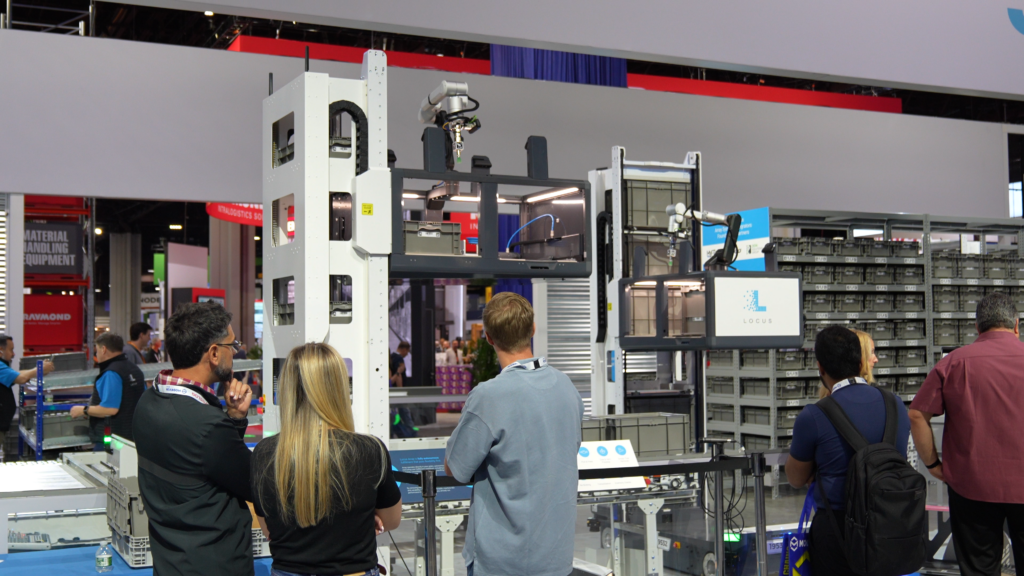
This is where systems like Locus Array come into focus — not as a supporting layer of automation, but as a clear expression of what fully autonomous Robots-to-Goods execution looks like in practice.
Within the broader approach defined by Locus Robotics, Locus Array represents a shift from assisting the operation to actively carrying it by continuously moving work, adapting to changes in real time, and reducing the operation’s dependence on fixed workflows or consistent labor availability.
It’s not just helping the plan succeed. It’s designed to keep fulfillment moving when the plan doesn’t hold.
Breaking the Link Between Headcount and Output
One of the biggest constraints in warehouse operations is how tightly output is tied to labor.
When headcount drops, output drops with it. When volume spikes, the only immediate lever is adding more people, which isn’t always possible on short notice.
That’s the relationship many operations are trying to break.
As Faulk noted, the question now is how quickly that redesign can happen as conditions change on the floor.
The model that’s emerging, driven by companies like Locus Robotics, shifts repetitive, high-frequency work into autonomous systems, while people focus on exceptions and coordination.
When that balance is right, throughput becomes more stable, even when conditions aren’t.
A Different Kind of Operational Confidence
Operational confidence in a warehouse used to come from predictability. You knew your volume, your labor, and your plan, and if those held, the operation performed.
That’s not the environment most warehouses are operating in anymore.
Today, confidence comes from knowing the operation will hold up when those inputs change — when labor fluctuates, when volume spikes, when order profiles shift midstream.
It’s the difference between hoping the plan holds and knowing the system can adjust when it doesn’t.
How Warehouse Operators Solve This Now
No operation avoids disruption anymore. The difference is how quickly it adjusts when things change.
The full webinar breaks down how leading teams are approaching that shift, and how Robots-to-Goods models are helping warehouses maintain flow when labor, volume, and demand don’t go as planned.
If you’re responsible for keeping warehouse throughput steady under changing conditions, it’s worth watching the full webinar on demand.