
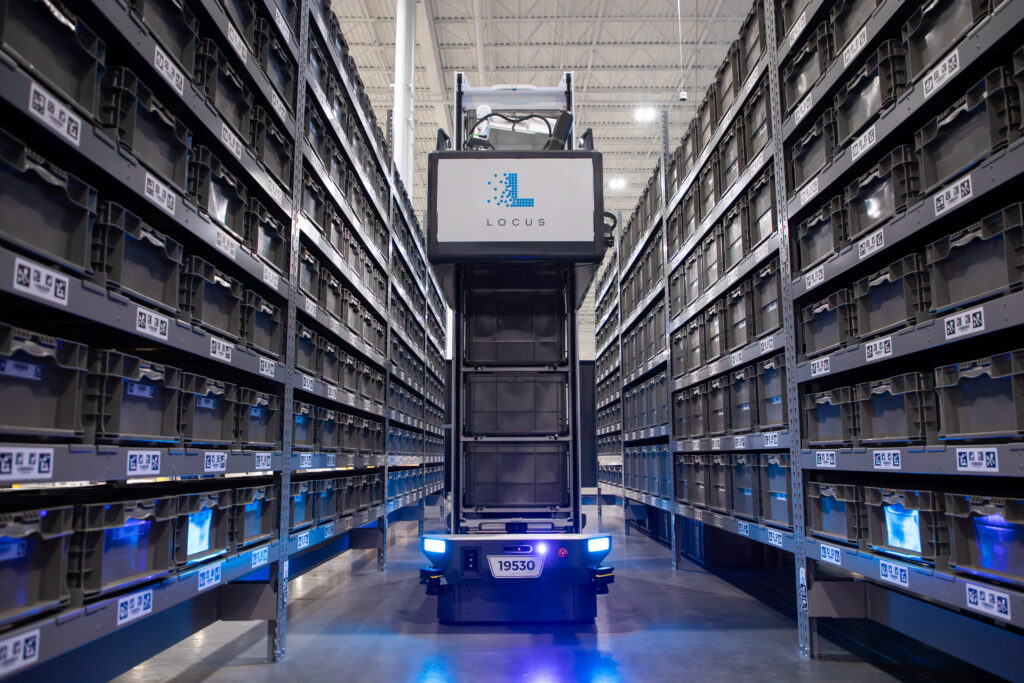
There is a moment in every technology company’s life when the work of years suddenly becomes visible to the world. When the compounding investments in infrastructure, learning, and capability crystallize into something new. Something that wasn’t possible before.
For Locus Robotics, that moment is now.
We are launching Locus Array — and to fully grasp what it truly represents, you need to understand the journey that made it possible.
The Problem We Set Out to Solve
When Locus Robotics was founded a decade ago, warehouses were already under pressure — eCommerce accelerating, labor markets tightening, SKU counts exploding. Yet the dominant automation technologies were built for a world defined by stability: fixed conveyors, goods-to-person stations, and AS/RS infrastructure that required enormous capital commitments and rigid facility layouts that couldn’t adapt when the business changed.
Our founding bet was that the future of warehouse automation wouldn’t be defined by bigger machines or more fixed infrastructure. It would be defined by intelligence, throughput, and flexibility. That we could bring automation to the warehouse as it already existed, not build around it.
It was not an obvious bet to make. But it turned out to be the right one.
Why Physical AI Changes Everything
AI has been stretched to cover nearly every software product on the market. Physical AI is something more specific — and more consequential. It is AI that perceives a dynamic physical environment, reasons about it in real time, and directs physical systems to act.
At Locus Robotics, that means robots that understand their environment and make intelligent decisions about how to navigate, pick, and coordinate with other robots in real workflows. Not theoretical. Operational.
Our rich data foundation powers something beyond better robots: Locus Agents — a new tier of AI built into the LocusONE™ platform that monitors operations in real time, adjusts autonomously, and manages workflows without waiting for human intervention.
Every new deployment deepens this advantage. Every new site, customer, and SKU makes the system smarter. The gap between Locus Robotics’s operational intelligence and anything a new entrant could build today isn’t just a head start. It’s a structural moat that widens with every pick.
Introducing Locus Array
Locus Array is not an incremental product update. It is a totally new automation architecture and the realization of the vision we started with ten years ago.
Where earlier generations of Locus Robotics robots focused primarily on assisting human workers, traveling through warehouses to reduce walking time, improve pick rates, and increase throughput, Locus Array moves decisively beyond task assistance. Array enables fully autonomous end-to-end workflows: inventory induction, robotic picking, order consolidation, and putaway operations, executed with minimal or no human interaction.
Locus Array represents Locus Robotics’s entry into what the industry is beginning to recognize as the next major automation category: Robots-to-Goods, or R2G. For years, the dominant paradigm for high-throughput warehouse automation was Goods-to-Person (G2P) and Automated Storage and Retrieval Systems (AS/RS) that move inventory to fixed human workstations. These technologies delivered meaningful productivity improvements, particularly in environments with stable demand and predictable product mixes. But they also introduced significant structural trade-offs.
Both G2P and traditional AS/RS require large upfront capital investments and extensive fixed infrastructure. Shuttle systems, cranes, dense rack structures, conveyors, and workstations are permanently embedded into the building itself. Once installed, these monuments are difficult to modify, expand, or reconfigure without major disruption and additional capital.
This rigidity becomes especially challenging in today’s fulfillment environment. SKU counts continue to grow, order profiles change frequently, and operators must adapt quickly to shifting demand patterns. When workflows evolve or throughput requirements change, fixed systems often require complex engineering changes or expensive facility modifications.
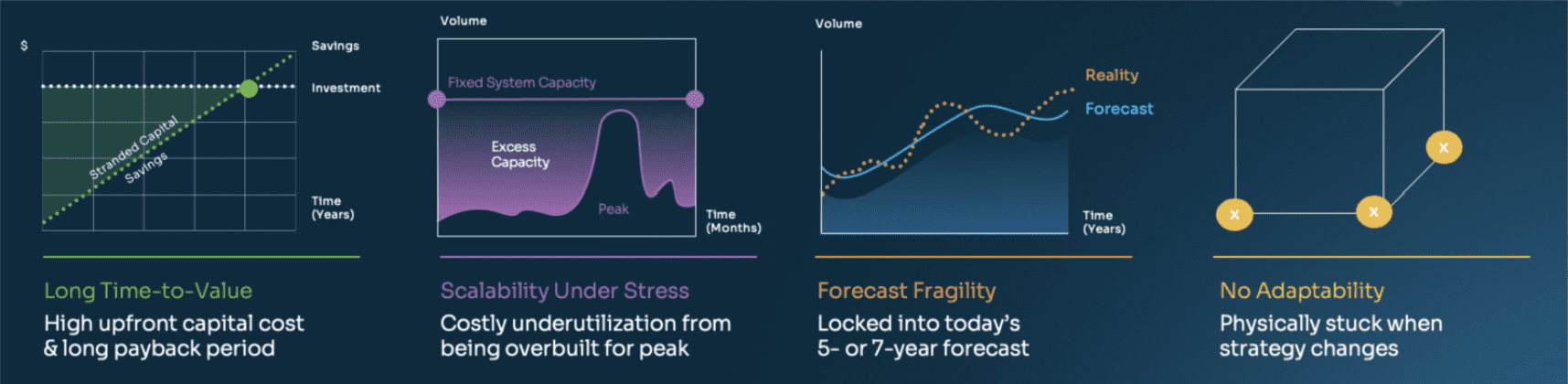
As a result, many operators find themselves constrained by automation architectures that were designed for stability rather than adaptability.
Robots-to-Goods Flips That Model
Instead of processing goods through fixed infrastructure to a stationary worker, autonomous robots move flexibly to the inventory and perform various tasks such as picking, putaway, and slotting. Locus Array was created specifically for this approach — merging Locus Robotics’s orchestration intelligence with autonomous robotic workflows.
Key Advantages
- Eliminates 90%+ of Labor While Improving Safety – Locus Array automates nearly the entire picking and replenishment process, removing over 90% of manual touches while eliminating the ergonomic and travel risks.
- Superior ROI & Lowest Cost per Pick – Locus Array achieves the lowest cost per pick and fastest payback period of any warehouse automation system in the market.
- Predictable, Machine-Like Performance – Locus Array delivers consistent, forecastable high throughput that’s immune to labor variability and ensures dependable performance shift after shift.
- Flexible & Extensible at Scale – Locus Array expands easily across zones, shifts, and sites — without costly reconfiguration — and adapts dynamically to changing volumes, workflows, and product mixes.
- Comprehensive SKU Coverage & High-Density Operation – Locus Array picks a wide range of SKUs across shapes, sizes, and packaging types while increasing storage density and reducing real-estate requirements. It also works in harmony with Locus Origin and Locus Vector to cover 100% of the SKU profile.
Locus Array is Designed for the Real World
- Fits Existing Facilities:
A compact 10-foot height profile allows Locus Array to operate within standard mezzanines and multi-level warehouse environments. - Limited Building Modifications Required:
Locus Array operates within existing warehouse footprints and requires only standard industry racking and totes rather than major structural changes or new infrastructure. - Modular and Expandable Architecture:
The system can be expanded incrementally as throughput grows with minimal disruption to live operations. - Configurable for Different Operations:
Flexible workflows allow Locus Array to adapt to different pick types, SKU profiles, and facility layouts. - Built for Production Environments:
Designed to operate reliably in high-volume warehouses supporting real-world e-commerce and distribution operations.
Locus Array also doesn’t operate in isolation. It is designed from the ground up to function within a broader Locus Robotics ecosystem. Locus Origin and Locus Vector robots handle a wide range of workflows. Locus Array coordinates with these capabilities into a unified, intelligent system — multiple robot types collaborating across the facility, each doing what it does best.
The RaaS Relationship: From Capital Commitment to Operating Leverage
Locus Robotics delivers Locus Array — like all of our automation solutions — through a Robots-as-a-Service (RaaS) model. This is not simply a billing preference. It is a fundamentally different relationship between an automation provider and the operators who depend on it.
Traditional automation requires operators to make large upfront capital commitments years before they can measure ROI. It requires them to predict future operational needs with precision, in an environment where those needs are increasingly unpredictable. And when business conditions change, they find themselves locked into infrastructure designed for a world that no longer exists.
RaaS inverts this dynamic. Operators access world-class automation without the capital burden. Costs scale with operations. Capacity can flex with demand. And the responsibility for continuous improvement — for keeping the system performing at its best as technology advances — rests with Locus Robotics, not with the customer.
What Comes Next
Ten years ago, we bet that intelligence, throughput, and flexibility would define the future of warehouse automation. Every robot deployed, every software release, every customer relationship, every one of those seven billion picks — all of it was in service of that bet.
Locus Array is not the end of that journey. It is the moment it starts to compound.
To the nearly 500 people at Locus Robotics who made this possible, and to the customers who put real robots on real floors and held us accountable — thank you.
The era of Physical AI in the warehouse has begun. We are ready.
Locus Array made its European debut at LogiMAT 2026, March 24–26, Stuttgart Trade Fair Centre, Stuttgart, Germany, followed by its North American debut at MODEX 2026, April 13–16, Atlanta. Join us at MODEX to see it in action.