
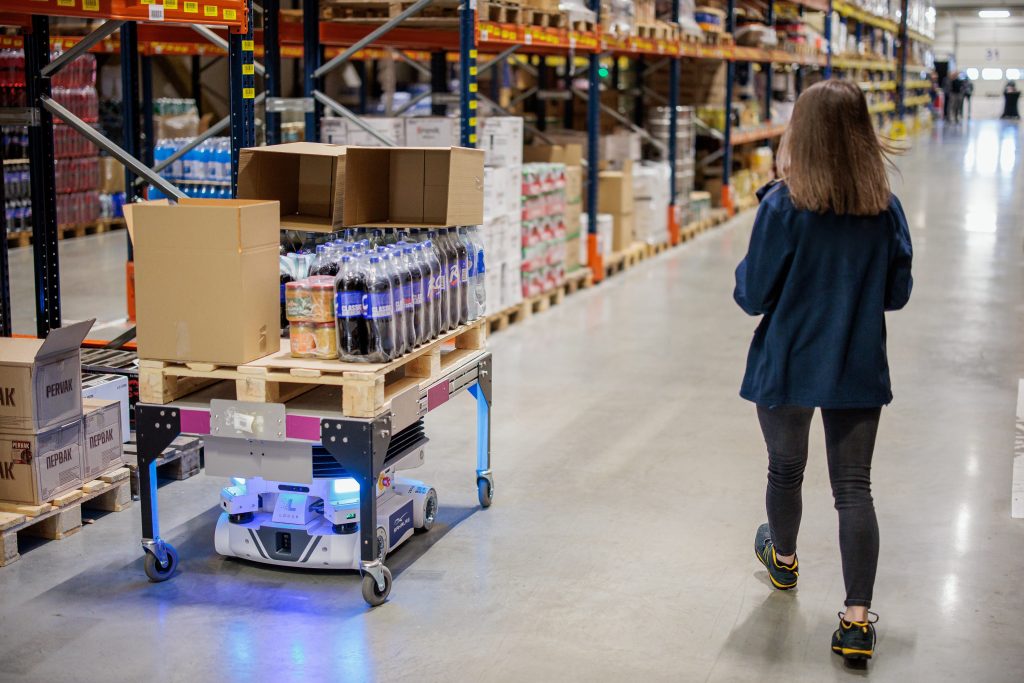
Most warehouse teams don’t need a dashboard to know when things are starting to slip because you can feel it in the shift.
Pick rates fall off pace; pack starts to back up; and a labor plan that looked solid in the morning changes by mid-shift as callouts and late arrivals add up. What should be a smooth flow turns into constant adjustment just to stay on track.
That’s the environment that warehouse automation decisions now have to operate in. It’s not a steady-state system, but one where order profiles shift, volume spikes without warning, and supervisors are constantly recalibrating to keep work moving.
This is what makes the AGV vs. AMR conversation worth revisiting. The difference isn’t just technical. It’s about how each approach holds up when the operation stops behaving the way it was designed to.
AGV vs AMR Explained
Before comparing how these systems perform under pressure, it helps to define the difference.
Automated Guided Vehicles (AGVs) follow fixed paths using wires, magnetic strips, or predefined routes. They are designed for repeatable, structured workflows where movement and processes remain consistent.
Autonomous Mobile Robots (AMRs), by contrast, navigate dynamically. Using sensors, vision systems, and software, they adjust routes in real time, avoid obstacles, and adapt to changing conditions on the warehouse floor.
At a high level, AGVs rely on predefined paths while AMRs make decisions in real time. That difference becomes clear the moment the floor stops going according to plan.
Why the AGV vs AMR Conversation has Changed
For years, AGVs were a reliable answer for structured, repeatable workflows. They follow fixed paths, execute predefined routes, and perform well in environments where variability is low and predictability is high.
That model still works in the right conditions, but the challenge is that those conditions are becoming harder to maintain.
In many facilities, the “steady state” is disappearing as promotions hit faster, SKU mixes shift more often, and returns add complexity to already tight workflows. What looked like a stable process six months ago now requires constant adjustment just to stay on plan.
In a recent episode of the Warehouse Automation Matterspodcast, one operations leader described how demand patterns have evolved:
“What we’re seeing now is more of that longer peak period that is ever evolving.”
Another put it even more directly:
“Something different changes every quarter, so you’ve got to be flexible.”
This is where AMRs began to gain traction as instead of relying on fixed infrastructure, they navigate dynamically, adjusting routes and tasks in real time based on what’s happening on the floor.
A simple way to think about it is that AGVs assume the operation will behave the way it was designed, while AMRs assume it won’t. And for many warehouse operations today, that distinction shows up every day on the floor.
What This Looks Like on the Warehouse Floor
The distinction between AGV and AMR isn’t abstract. It shows up in the moments operators deal with every day, often in ways that don’t show up on a dashboard.
Consider a typical shift:
- A sudden spike in orders pushes pick demand beyond the planned labor allocation
- A portion of the workforce doesn’t show up for second shift
- A high-velocity SKU moves locations, forcing changes to pick paths
- Pack stations begin to back up as upstream flow becomes uneven
None of these are unusual as they’re the kinds of adjustments teams make every day just to keep the floor from falling behind.
In a fixed-path environment, even small changes can create friction. Adjusting routes may require reprogramming. Physical changes to the layout can trigger downtime or coordination across multiple teams. The system performs well when conditions match the original design but starts to strain when they don’t.
With AMRs, those same disruptions are absorbed differently. Routes adjust dynamically. Work is rebalanced across available resources. The system keeps moving without requiring the same level of intervention or redesign.
For operators, that difference often comes down to less time putting out fires and more time actually running the operation.
Beyond the Robot: Why System Design Matters
The conversation has also moved beyond individual robots to how the entire system is structured and how that system can evolve over time.
Many warehouse automation decisions still begin with a single workflow. That might be picking, putaway, or transport — focused on solving a specific constraint like reducing walking, improving accuracy, or stabilizing throughput in one area. And in many cases, that’s the right place to start.
But warehouse operations don’t run in isolation. What happens in picking affects pack. What backs up at pack impacts inbound flow. A delay in putaway can ripple into replenishment and downstream fulfillment. Everything is connected, whether the system is designed that way or not.
That’s where warehouse flexibility starts to matter more. Not because every operation needs to automate every workflow at once, but because most operations don’t stay static.
A system that can expand across workflows, and adjust as those workflows change, gives operators more control over how the operation evolves. Instead of redesigning the facility every time demand shifts or a new constraint emerges, they can build on what’s already in place.
This is where Locus Robotics has focused our approach to give operators a starting point that delivers immediate value, with the ability to extend and adapt the system as the operation grows and changes.
A Coordinated Approach to Flexible Automation
Rather than treating automation as a set of standalone tools, Locus Robotics has built a coordinated system that aligns different capabilities within a single platform.
Locus Origin supports high-volume picking by reducing walking and improving consistency across shifts. Locus Vector handles heavier transport and movement across the facility. Locus Array introduces a Robots‑to‑Goods (R2G) model, bringing a vision‑guided robotic arm directly to inventory stored in vertically optimized shelving to deliver higher storage density than manual operations and fully autonomous execution across multiple workflows.
These systems are unified through the LocusONE™ platform, which orchestrates robots, people, and workflows in real time.
What matters here isn’t just the individual technologies, but how they work together under real operating conditions. Operators can deploy the right capability for each part of the operation without redesigning the entire system. And as volume shifts or workflows change, the system adjusts with them.
That kind of flexibility shows up in a very practical way on the floor where teams can respond to change without starting over.
Choosing the Right Path Forward
The decision between AGV and AMR is about how your warehouse operation handles change instead of strictly being about automation.AGVs still have a place in environments where workflows are stable and predictable. In those settings, their efficiency and reliability remain valuable.
But for many warehouses, stability is no longer guaranteed as volume moves faster, order profiles shift more frequently, and labor availability changes day to day.In that environment, the ability to adjust without disrupting the operation becomes critical.
For warehouse and operations leaders, the question is less about which technology is more advanced and more about which approach aligns with how their operation actually runs today.
If you’re evaluating how to bring more consistency and control to your operation, it helps to look beyond individual technologies and focus on how your entire system performs under pressure.
Connect with Locus Robotics to see how a coordinated, flexibility-first approach can help you maintain throughput, adapt to changing conditions, and keep your operation running smoothly, no matter what the day brings.