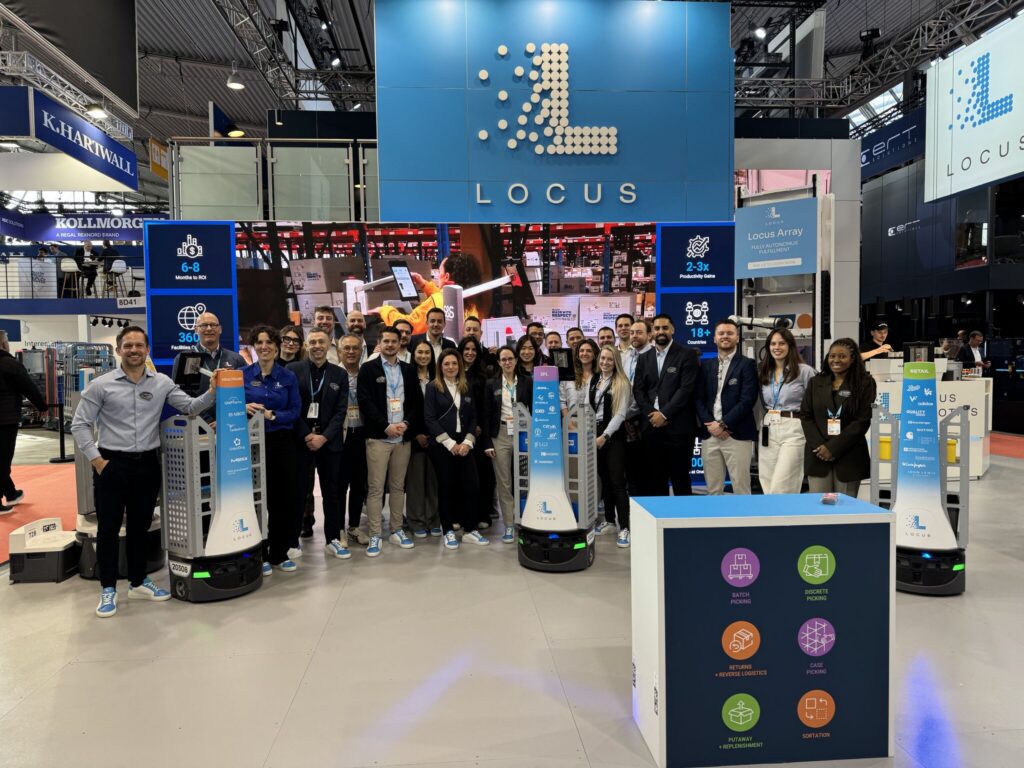
1,671 exhibitors from 46 countries. 69,856 visitors over three days. And all across 68,969 square meters (10 halls!) of exhibit space at the Messe Stuttgart convention center?
It can only have been LogiMAT 2026!
And what a show. Beyond the showcases (and yes, that notable demo shutdown) this year, our conversations at LogiMAT made one thing clear; conversations around warehouse automation are shifting.
LogiMAT 2026: What We Saw
Walking the show floor, a few patterns stood out compared to previous years:
Traditional ASRS are Pushing Toward Flexibility: There was a strong concentration of high-density storage and retrieval systems at the show — particularly cube, tote, and case-based architectures. Most of these solutions are built around fixed infrastructure, with robots or shuttles delivering inventory to stationary picking stations. The dominant innovation theme across ASRS vendors was clear: how do you make inherently rigid architectures more adaptable? This tension defines the core challenge facing modern facilities — maximizing density and throughput without sacrificing the operational flexibility that today's fulfillment demands require.
Pallet Storage and Movement Remained a Focus: Alongside this, pallet storage and movement remained a major focus area. Many solutions centered on automating pallet handling within structured environments, often paired with case or tote picking systems. In several demonstrations, case picking was increasingly handled within the aisle itself, with systems designed to reach into racking and retrieve items directly from storage locations.
This highlights a continued push toward higher density and more automated picking, but typically within predefined operating conditions - presenting a challenge when things change.
Flexibility is Key: “Flexibility” was one of the most common terms used across the show. It appeared in messaging across a wide range of solutions, including those built on fixed infrastructure. But in many cases, that flexibility was limited to configuration within a defined system, rather than the ability to adapt the operation itself as conditions change.
Fewer AMR Options: Another notable shift was the reduced presence of mobile, collaborative robotics compared with other years. Earlier events saw a wider range of solutions designed to move dynamically through warehouse environments.
This year, the focus leaned more heavily toward structured, infrastructure-based systems, with fewer solutions designed to operate flexibly across changing workflows.
What These Changes Reveal: A Demand For Performance, and Need for Agility
Taken together, these shifts point to an underlying tension in the market.
On one hand, there’s continued demand for high-performance, high-throughput systems. On the other, operators are increasingly asking how those systems can adapt when demand shifts, labor fluctuates, or workflows need to change quickly.
This was also a recurring theme in our conversations throughout the event.
Where previous years have seen a focus on efficiency, throughput, and cost per pick, today’s markets are under pressure, with operational predictability no longer guaranteed.
And reflecting that, at LogiMAT, we saw that mindset shift coming through. Evaluation criteria are moving beyond static points like:
- “How fast can this system pick?”
- “What is the maximum throughput?”
And are moving towards questions around operational adaptability, like:
- “How can this system respond when demand doubles?”
- “What happens if my labor availability drops?”
- “Can this scale without rebuilding the facility?”
In our conversations, we’re seeing that operations today need:
- The ability to scale capacity without long-term infrastructure lock-in
- Fast deployment without disruption to existing operations
- Continuous performance improvement driven by real operational data
- Flexibility that’s built in, across multiple workflows and not limited or fixed in a single use case
These are no longer “nice to have” capabilities; they’re becoming baseline expectations for organizations who operate in volatile environments.
Operating in Volatility: Real-World Examples
This shift is already visible in live operations.
Across different industries, companies are moving away from fixed capacity planning and toward models that can adjust as demand changes, particularly in environments where volume is difficult to predict.
As examples:
- The Quality Group (TQG), is one of Europe’s fastest-growing eCommerce providers of sports nutrition and lifestyle supplement brands, and sees huge demand fluctuation, often driven by social media and influencer activity. In just over a year since go-live, the operation has surpassed 30 million picks, and can reach up to 500,000 units per day.
- A similar pattern is visible in 3PL environments. ITG, supports a premium retail brand, and operates within a high-density, constrained facility where demand can surge rapidly during peak events. Within the first year, the site processed over 140,000 orders and achieved more than 2 million units picked, alongside measurable improvements in operational performance.
Beyond numbers or scale alone, these cases reflect that broader shift; the need to maintain consistent performance despite highly variable demand — with the ability to scale capacity in line with actual order volume, rather than planning for a fixed peak.
From LogiMAT to MODEX: What’s Next in Adaptable Automation?
Our most important takeaway from LogiMAT 2026?
Warehouse automation is no longer about designing for a fixed state. Operations need the ability to maintain performance as conditions change, whether that’s demand spikes, labor variability, or shifting order profiles.
Across the show, that shift was evident in both the questions being asked and the gaps still being addressed.
And while many solutions continue to optimize for stability, operators are increasingly prioritizing systems that can adjust as and when reality deviates from the plan.
Looking ahead to MODEX 2026, it’s a trend and progression that we’re only expecting will continue.


 Article