
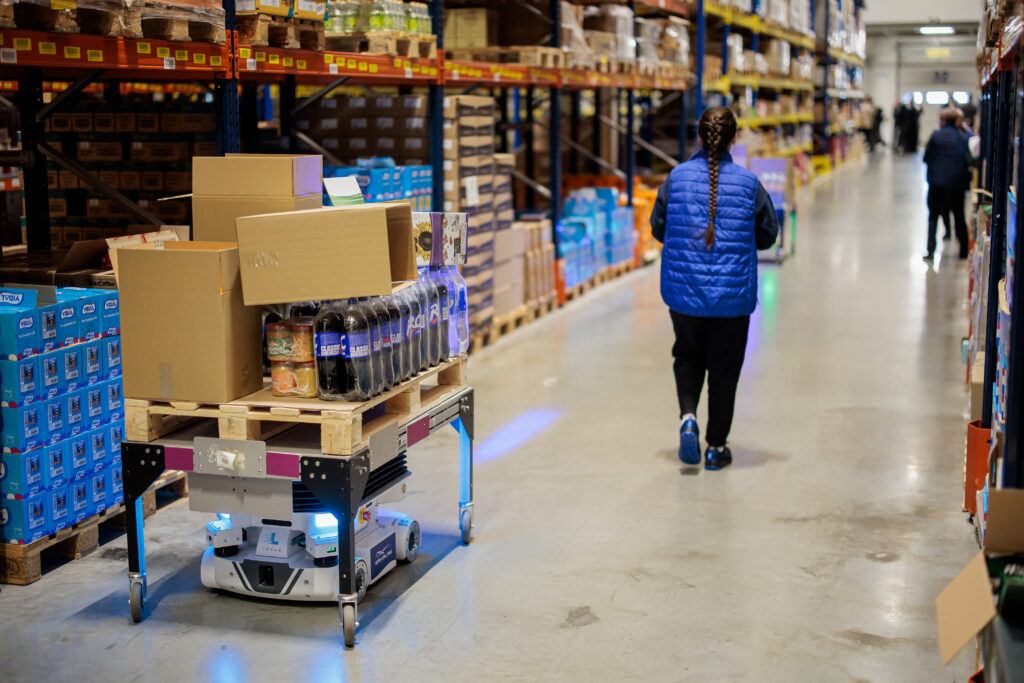
On March 2, 2026, inside a Ryder warehouse, a warehouse associate working alongside a Locus Origin robot (unit #9099) picked a plum tank top.
It was a standard, high-volume fulfillment workflow. An associate retrieved the item; the robot carried it to the next station; and the order continued through the warehouse. The moment itself looked ordinary, but that single pick marked the seven billionth pick completed by our Locus Robotics autonomous mobile robots (AMRs) for customers worldwide.
For warehouse operators, moments like this matter less as milestones and more as signals of how quickly automation is becoming part of everyday execution. What matters is not the number, but the speed at which networks like this are scaling — and what that signals about where warehouse automation is headed.
The milestone arrived just four and a half months after the six billion mark. This acceleration says less about a milestone and more about how quickly flexible automation is becoming part of everyday warehouse operations. It is the shortest interval between milestones so far, highlighting how quickly automation is spreading across multi-site fulfillment networks.
A Network That Keeps Expanding
Seven billion Locus Robotics AMR picks did not happen inside a single warehouse, or even within a single customer operation. They represent activity across hundreds of fulfillment sites across North America, Europe, and Asia-Pacific.
Over the past several years, deployments have expanded rapidly across omnichannel retail, third-party logistics (3PL), healthcare fulfillment, and industrial distribution operations — environments where SKU counts are high and labor availability can change from shift to shift. Thousands of robots now operate across customer sites worldwide to support picking operations that run across multiple shifts and multiple continents.
Most of those picks have been completed through the Person-to-Goods (P2G) model using Locus Origin and Locus Vector robots. In these environments, warehouse associates and robots work in coordinated workflows where robots handle travel while people focus on the picking task itself.
As more organizations deploy robots across their fulfillment networks — and expand those fleets over time — the cumulative activity of those robots accelerates, which is why each billion picks milestone is arriving faster than the last.
From Robotics Projects to Fulfillment Infrastructure
Not long ago, many warehouse robotics deployments began as exploratory initiatives. Operators tested a limited number of robots to evaluate performance before deciding whether to scale, but today, the conversation has changed.
For many warehouse operators, robotics are a permanent part of their operating infrastructure rather than a short-term project. Fleets grow as order volumes increase, and robots that initially supported peak demand begin operating year-round.
This expansion across facilities creates a compounding effect as each new deployment adds more robots to the global network, and each robot contributes thousands of picks per day. Over time, the scale of that activity accelerates dramatically.
Seven billion picks is the cumulative result of thousands of ordinary warehouse shifts where robotics quietly became part of daily fulfillment execution. This pattern mirrors what we’re seeing across the industry with automation shifting from discrete projects to embedded operational strategy.
Why Speed Between Milestones Matters
Milestones attract attention because of the numbers involved.
The shrinking time between billion-pick milestones reflects how automation adoption is evolving.
Warehouse robotics is no longer concentrated in isolated facilities. It is spreading across entire fulfillment networks as operators look for ways to increase productivity while maintaining flexibility.
That flexibility matters more than ever as SKU assortments expand; demand patterns shift faster than traditional planning models anticipate; and labor availability changes from week to week. In that environment, warehouses need infrastructure capable of adapting without major facility redesigns.
Flexible robotics systems help provide that adaptability by allowing operators to scale capacity, adjust workflows, and maintain throughput as conditions change.
The faster arrival of each new milestone suggests that more organizations are building their operations around that model.
What Comes Next for Warehouse Automation
While most of the seven billion picks were completed through Locus Origin and Locus Vector robots, the next phase of warehouse automation is coming into view.
We have shipped the first units of Locus Array, a Robots-to-Goods (R2G) system designed to automate additional stages of fulfillment, including inventory storage, retrieval, and order consolidation. The bigger shift is that R2G automation is starting to move from concept into real warehouse deployments.
As more Locus Array units appear in customer sites, warehouses will be able to combine P2G and R2G workflows within the same operation, extending robotics across more of the fulfillment process.
As those capabilities expand across more facilities, the scale of robotic activity across the global network will grow even further.
Which means the pace behind the next billion picks is unlikely to slow down.
What Seven Billion Picks Really Signals
For warehouse operators, milestones like this are less about celebration and more about confirmation. They show what happens when robotics becomes embedded in daily fulfillment operations, supporting associates while helping organizations maintain consistent throughput under changing conditions.
The seven billionth pick happened to be a plum tank top retrieved alongside Locus Origin robot #9099 inside a Ryder warehouse. It was a small task within a much larger system of activity happening across fulfillment operations around the world.
Multiply moments like that across thousands of robots, hundreds of facilities, and millions of daily orders, and the scale of modern warehouse automation begins to come into focus.
Seven billion picks is not just a milestone. It reflects what becomes possible when warehouse automation is designed for flexibility, scalability, and real-world execution.
If you are evaluating how robotics could help your operation scale productivity, adapt to demand variability, and strengthen operational confidence, connect with the team at Locus Robotics to start the conversation.