Over the past few years, I’ve had the opportunity to speak with dozens of warehouse and supply chain leaders across retail, 3PLs, healthcare, and large-scale distribution networks. Some of these conversations happen on the “Warehouse Automation Matters” podcast, while others come through customer case studies, partner interviews, or working sessions focused on how operations are evolving under constant pressure.
The organizations are different. The roles vary, and the scale ranges from fast-growing regional operations to some of the largest logistics networks in the world.
But the message has become remarkably consistent that operating a warehouse today feels fundamentally different than it did even five years ago.
Not because leaders have forgotten how to plan or optimize, but because the environment those plans were built for no longer exists.
Uncertainty Has Become the New Warehouse Baseline
Across conversations, change is no longer described as an exception to manage. It’s treated as part of the daily operating rhythm.
Demand patterns are less predictable. Labor availability fluctuates. Order profiles shift quickly, and new requirements arrive before the last change is fully absorbed. Leaders talk less about preparing for warehouse “disruption” and more about managing continuous variability as a fact of life.
As Adam Lawicki, VP of Strategy at scale3PL, put it during our conversation,
“This isn’t a seasonal spike anymore. This is a new baseline operation.”
What’s striking is how often that sentiment is echoed, even when the context changes. Whether I’m speaking with a retailer about navigating promotional surges, a healthcare distributor managing sensitive fulfillment requirements, or a large network operator balancing volume across facilities, the pressure sounds familiar.
Planning horizons are shorter. Assumptions expire faster. And leaders have largely accepted that warehouse uncertainty isn’t something to wait out — it’s something to design around. This is why flexibility-first automation has become essential because it’s not about eliminating variability but thriving within it.
Optimization Alone Isn’t Enough Anymore
For years, warehouse performance was defined by optimization in dialing in layouts, refining labor models, and eliminating inefficiencies wherever possible.
Those disciplines still matter. But what I hear consistently is that warehouse optimization on its own no longer guarantees success.
Leaders describe systems that perform well under ideal conditions but become fragile when reality intervenes. A sudden surge. A labor gap. A shift in order mix. In those moments, the question isn’t whether the operation is optimized — it’s whether it can hold together without constant intervention.
This perspective comes up across both customers and partners, not as a rejection of efficiency, but as an acknowledgment of its limits in a world where conditions change constantly.
Warehouse Flexibility Keeps Coming Up for a Reason
Across industries and roles, warehouse flexibility is one of the most consistent themes and it’s rarely framed as a nice-to-have.
In a conversation with Conectiv Supply Chain Solutions, a 3PL supporting a wide range of industries, Kevin Sullivan described flexibility as something foundational:
“Flexibility was just inherent in everything that we did.”
That idea surfaces repeatedly in different forms. Leaders talk about flexibility as protection against overcommitting to assumptions that won’t hold, and against locking operations into configurations that are costly to change.
What’s notable is that flexibility isn’t described as chaos or compromise. It’s described as intentional optionality and the ability to adjust without disruption, to scale without redesign, and to evolve without destabilizing the operation.
Confidence Is the Quiet Priority Behind Every Conversation
Very few leaders explicitly say they’re chasing “confidence.” But listen closely, and it’s everywhere.
Confidence shows up as fewer surprises on the floor.
As trust in inventory and execution.
As knowing what will happen when volumes change, rather than reacting after the fact.
In healthcare-focused conversations especially, confidence is tied directly to risk. Leaders talk about reliability, traceability, and predictability because the cost of uncertainty is high. In large-scale networks, confidence shows up as calm with warehouse operations that don’t swing wildly between overcapacity and fire drills.
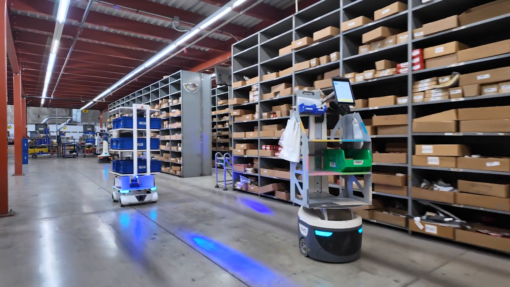
At Dental City, leaders described how their operation adapts in real time with Locus Robotics’ autonomous mobile robots (AMRs) rather than reacting after disruptions occur:
“If we have significant spikes during the day, we’re able to adapt to that with our robotics.”
That statement captures a broader pattern I hear across industries. Confidence isn’t about eliminating variability. It’s about understanding how the operation will respond when variability shows up and trusting that response.
A Path Forward in an Uncertain World
Uncertainty isn’t something warehouse leaders can wait out. It’s something they have to operate within every day. And as these conversations continue, it’s clear that outperforming now requires a different foundation than it did in the past.
The operations that stand out aren’t chasing perfect optimization under ideal conditions. They’re designing for change. They’re prioritizing flexibility, predictable outcomes, and the ability to adapt without disruption. They’re building confidence into their operations, not just efficiency into their workflows.
That’s the idea behind Locus Robotics’ flexibility-first automation — technology designed to move with the operation as conditions change, rather than locking it into assumptions that won’t hold. For organizations navigating constant variability, it offers a way to scale, adjust, and perform reliably even when the environment is anything but stable.
If you’re thinking about how to outperform in an uncertain world — and what it takes to build operations that can flex, adapt, and move forward with confidence — Locus Robotics is working with warehouse leaders every day to make that possible. Learn more about how flexibility-first automation can help your operation stay resilient, responsive, and ready for whatever comes next.


 Article