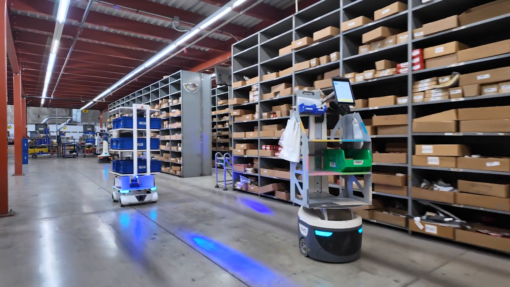
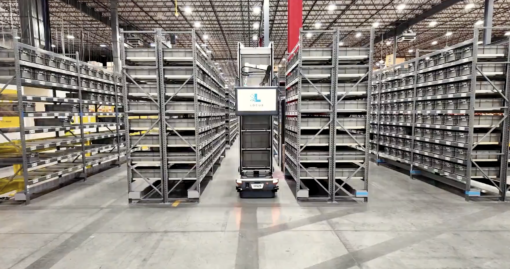
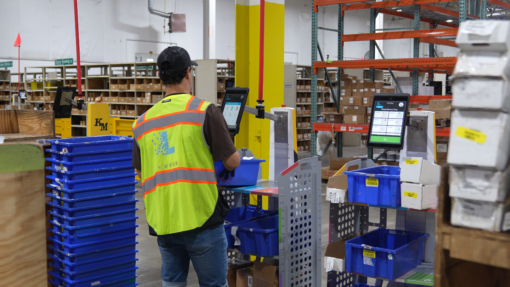
Artificial intelligence (AI) isn’t new to the warehouse. What’s new is how it’s being talked about.
Many vendors seem to have an “AI story,” that is often powered by simulations or synthetic data. These models look good in demos, but the moment they meet real-world complexity, such as shifting SKUs, unpredictable traffic, and varying layouts, their performance starts to crumble.
The truth is simple: AI trained on simulated data can only solve simulated problems. To successfully work in a warehouse, AI needs to be trained in one, and at Locus Robotics, we know that real-world complexity demands real-world data.
The Real Difference Between Real and Synthetic Data
Synthetic or simulated data does have value since it’s fast, safe, and helps prototype new models. But if you rely on it entirely, you’re teaching your AI about a warehouse world that doesn’t exist — you'll spend all your time closing the “sim-to-real" gap and then using complex techniques for “Domain Adaptation,” when instead you could be solving the real problem with real data for robotics.
This is where “overfitting” comes in, which happens when a warehouse automation AI model learns a pattern so narrowly that it can’t generalize to new conditions. It’s also the reason a model that works beautifully in one facility might completely misfire in another.
One of my favorite examples comes from an old AI urban legend that a team trained a neural network to distinguish between American and Russian tanks. The model performed flawlessly in testing until it failed miserably in the field. Why did this happen? Because all the photos of American tanks were taken on sunny days in California, while the Russian tanks were photographed under cloudy skies. The AI hadn’t learned to recognize tanks at all. It had learned to recognize the weather. Whether this urban legend is true or not doesn’t really matter, what matters is that overfitting happens in sometimes funny ways, but it’s not always that easy to spot and it can be catastrophic, such as when AI generated racist decisions.
Warehouses are in the same situation. You can’t train AI on “perfect data” from a single site and expect it to perform in 350 unique environments. Real data, with all its noise, variation, and unpredictability, is what makes intelligence transferable.
When AI Trains on AI
There’s another growing risk in our industry of AI models trained on other AI-generated data.
Today, estimates suggest that up to 70% of the internet is AI-generated content. When new models use that content for training, the results deteriorate fast. After just a few generations of “AI feeding AI,” the outputs turn to gibberish, creating “AI Slop” that quickly diminishes in value and impact, but can be hard to spot. Imagine what “AI Slop” for the warehouse could look like?
The same applies in warehousing as you can’t train an AI on simulated workflows or artificially generated performance data and expect it to navigate real-world logistics. Synthetic data can augment a small percentage of your training set, but it can’t form the foundation. If you want AI that can reason in the physical world, you need to teach it about the physical world.
Scale Is What Turns Data into Intelligence
Here’s what many companies get wrong: building a model that works in one warehouse isn’t an achievement — it’s overfitting. Building AI that performs reliably across hundreds of sites, thousands of robots, and millions of missions is the real challenge.
At Locus Robotics, we've spent more than a decade collecting and learning from real operational data, which includes:
- 6 billion tasks completed
- 150 million miles of robot travel
- 350+ sites across 19 countries
That scale creates what we call our data moat, which is a competitive advantage built not just on volume, but on diversity. Locus Origin and Locus Vector, both powered by LocusONE™, operate in different geographies, climates, industries, social contexts, and facility types, and that breadth and depth of experience allows our AI to generalize and handle “sunny day” and “cloudy day” scenarios equally well.
The Power of Pairing Sensor Data with Business Context
Another common misconception is that images or sensor data alone are enough to train AI. In the warehouse, context is everything.
A robot’s sensors can tell you what it sees, such as a box, a bin, or a rack, but not why it matters. When we pair that sensor data with business metadata (orders, SKUs, mission types, and labor patterns), we transform raw perception into operational intelligence to improve fulfillment speed and accuracy for Locus Robotics’ customers.
That’s what enables physical AI — systems that don’t just perceive the environment but understand it. Every pick, every path, and every completed mission adds to the feedback loop that makes our AI smarter, safer, and more adaptable over time.
Why Real Data Is the Real Differentiator
As well as powering AI, real data also protects AI.
It prevents AI hallucinations, reduces bias, and ensures that models reflect how warehouses truly work and not just how we imagine them to work. It’s what lets our customers trust that when our AI makes a recommendation, it’s grounded in reality and not probability.
The best AI doesn’t need more imagination. It needs more reality.
At Locus Robotics, that reality is captured in every movement, every mission, and every interaction across our global fleet. That’s the warehouse AI advantage, and it’s built on the kind of data you can’t simulate.
To learn more, watch our on-demand webinar, “Practical Uses of AI in the Warehouse,” to see how data-driven intelligence shapes the future of warehouse operations and then explore our AI-driven warehouse solutions.
Author Bio:
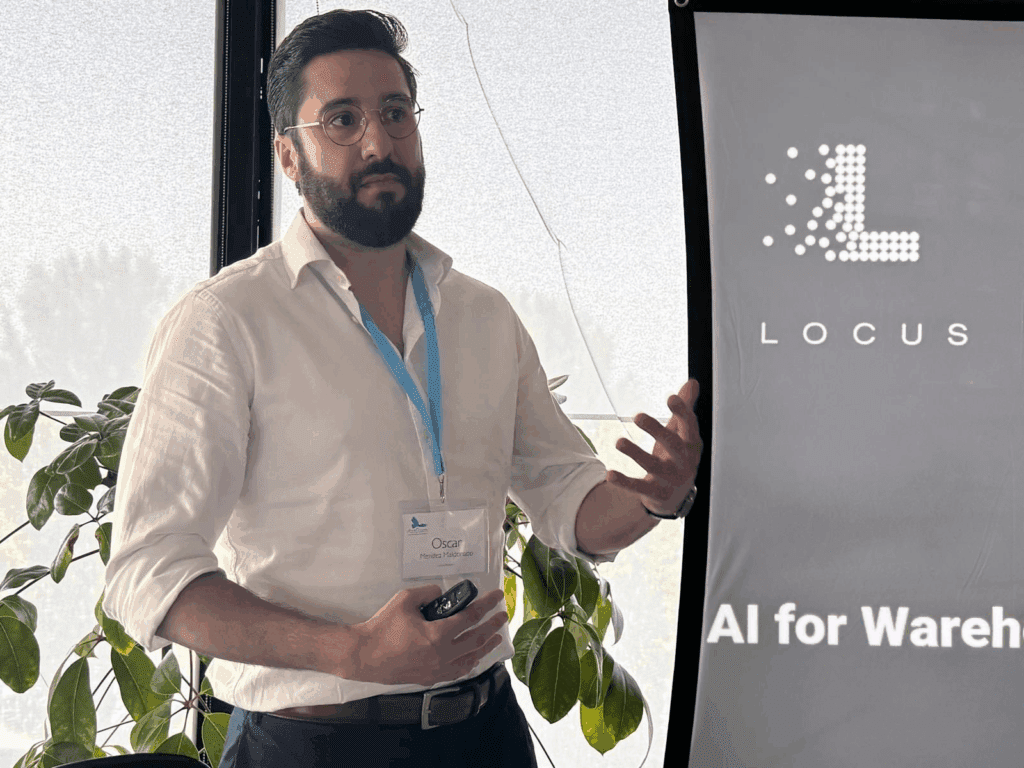
Oscar Mendez is the Director of the AI & Data Sciences (ADS) Team at Locus Robotics, overseeing deployment of AI-based improvements for a fleet of over 15,000 robots. His focus is on developing AI company-wide AI strategies, engaging in academic research, and applying cutting-edge Physical AI, Computer Vision and Robotics methods to warehouse logistics. Mendez is also concentrated on building the world's first logistics-centric AI foundation models that will deliver real value to warehouse operations.


 Article