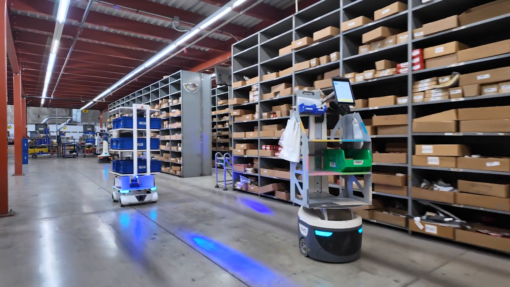
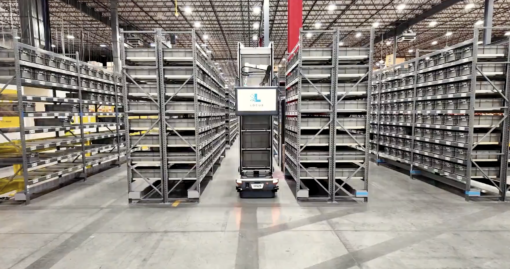
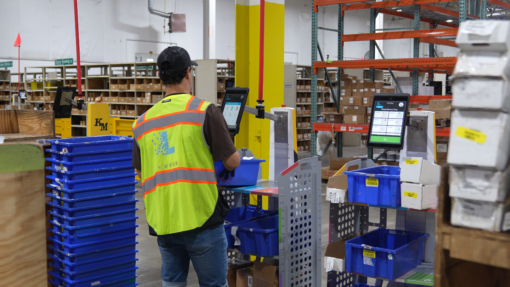
Every company is talking about artificial intelligence (AI), but few are clear about what it actually does. At Locus Robotics, we’re turning AI from theory into measurable impact on the warehouse floor,
In the warehouse, AI isn’t a buzzword or a far-off concept. It’s a tool that’s already improving how people, robots, and warehouse systems work together to keep operations moving at speed, yet many leaders still wonder how to separate what’s real from what’s just noise.
That’s why I recently hosted the webinar, “The Practical Uses of AI in the Warehouse,” to look at how AI is already delivering measurable value on the floor, not just in theory or in pilot projects.
Why “AI” Means Something Different in the Warehouse
When most people think of AI, they picture chatbots or content generators because that’s what they see on the news. In reality, warehouse AI operates on a very different level that’s physical, immediate, and constantly changing.
Warehouses are dynamic ecosystems where products move in, out, and around, while conditions shift by the minute. That’s why AI in this environment must be both intelligent and adaptive. It needs to see, decide, and act, often in collaboration with humans.
At Locus Robotics, we think about this in terms of physical AI, which relates to intelligent systems that interact with the real world, not just analyze it. Every Locus robot is an intelligent agent that learns from data, responds to changing workflows, and scales across multi-level mezzanines and diverse environments.
But technology alone isn’t enough. It’s the domain expertise — the deep understanding of how warehouses actually run — that makes AI practical. Knowing the difference between a forklift and a lift truck isn’t just trivia. It’s the kind of contextual awareness that determines whether your AI makes smart, safe, and efficient decisions.
Data Is the Foundation and the Differentiator
AI is only as good as the data it learns from, so if you feed it bad data, you’ll get bad results — no matter how advanced the model.
At Locus Robotics, we’ve built a foundation of real-world operational data from over a decade of warehouse activity in billions of pick missions, millions of miles of robot movement, and hundreds of thousands of human–robot interactions across 325+ sites and AI is embedded across our entire product suite. No other provider has this scale of operational intelligence.
That data gives us something that synthetic data simply can’t, which is variety, accuracy, and scale. It’s what makes our AI systems not just predictive, but trustworthy.
And in an industry where downtime and inefficiency have real costs, trustworthy AI is the difference between interesting and impactful.
From Smart Robots to Smarter Operations
AI in the warehouse is about much more than navigation or speed. It’s about orchestration and how tasks, people, and machines align in real time.
Through our LocusONE platform and central AI orchestration engine, AI now helps coordinate workflows across entire facilities:
- System-Directed Labor (SDL) ensures people and robots work in sync and respond instantly to changing demand.
- AI-Powered Picking uses computer vision to identify and retrieve items with precision, cutting errors and labor needs dramatically.
- Agentic Systems let managers ask natural-language questions like “How is my warehouse performing today?” and receive real-time, data-driven answers.
The result isn’t just efficiency. It’s agility where warehouses can scale up or down, reassign resources, and make decisions in minutes instead of hours, all without adding complexity.
Building Toward Full Warehouse Autonomy
Every warehouse leader asks the same question: How far can AI really go?
The honest answer is that we’re already closer to full autonomy than most realize. Systems like Locus Array compliment Locus Origin and Locus Vector to help warehouses move toward zero-touch order fulfillment to handle repetitive tasks with speed and accuracy while freeing people to focus on higher-value work.
But autonomy isn’t a switch you flip. It’s a journey built on three essentials:
- Accurate, clean data
- The right technology partners
- Operational readiness and team training
Those who prepare now and treat AI not as an experiment but as a capability, will have a real competitive edge when warehouse automation becomes the standard and not the exception.
AI in the warehouse isn’t theoretical anymore. It’s physical, measurable, and here.
What separates the leaders from the laggards isn’t whether they adopt AI — it’s how they do it: with clarity, with data, and with people at the center.
Because at its best, warehouse AI isn’t replacing human intelligence. It’s amplifying it.
Watch the full conversation on demand: The Practical Uses of AI in the Warehouse and then discover how Locus Robotics can help you harness practical AI — explore LocusONE™ and our AMR portfolio today.



 Article