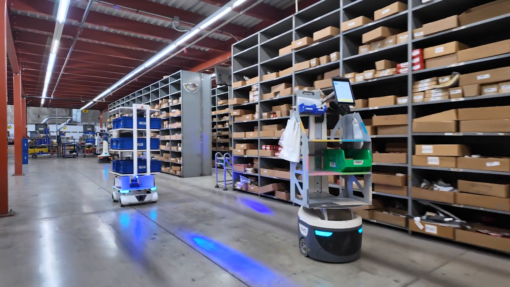
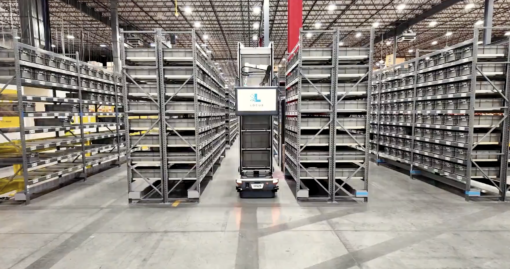
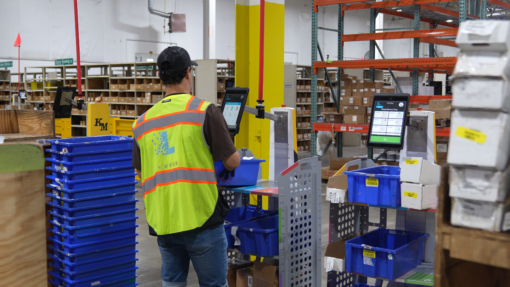
Every warehouse hides inefficiencies in plain sight like unnecessary travel, unbalanced zones, extra touches between pick and pack. What separates the leaders from the laggards isn’t the equipment on the floor, but the discipline behind the data.
At Staples Canada, automation didn’t begin with robots. It began with engineers, spreadsheets, and a simple principle: you can’t automate what you don’t understand. Before a single Locus Robotics autonomous mobile robot (AMR) entered the building, the team analyzed millions of transactions to understand how their fulfillment network really worked.
“We started with lots and lots and lots of data pulls,” said Mert Selcuk, Senior Manager of Supply Chain Strategy and Capabilities, during his appearance on the “Warehouse Automation Matters” podcast. “Our goal was to identify inefficiencies we could quantify and improve and not just automate for the sake of it.”
Turning Data into Warehouse Automation Design
The Staples’ engineering team began by building a detailed operational blueprint of SKU velocity by zone, order lifecycle timing, picker travel paths, and batch composition, which was a business-led investigation into how work actually happened.
“Every warehouse has the same challenge,” Selcuk said. “If you don’t know your data, you can’t design for improvement.”
Rather than adopting automation wholesale, Staples Canada applied a flexibility-first approach, building multiple proof-of-concept models grounded in real metrics. Each design was tested against throughput goals and operational constraints, ensuring ROI and scalability before deployment, When the data showed that mobility, not mechanization, would deliver the greatest efficiency gains, Staples moved forward with Locus Robotics’ AMRs.
Engineering and Automation Partnership
From the start, the relationship between Staples Canada and Locus Robotics looked more like an engineering collaboration than a technology purchase. The two teams worked in parallel to build validation models that aligned with Staples’ data definitions to ensure that every improvement could be measured the same way internally and externally.
Using LocusHub analytics, the joint team monitored units per hour (UPH), cycle time, and accuracy in real time. When results fluctuated, engineers on both sides investigated causes together. “During one of our meetings,” Selcuk recalled, “our senior director said he couldn’t tell who was Staples and who was Locus Robotics. That’s when we knew we were fully aligned.”
The results spoke for themselves:
- Productivity nearly doubled from 42 to 82 UPH.
- Cycle time dropped by 70%.
- Accuracy increased by 73%, eliminating the need for a separate QC step.
- Ramp-up time shrank from six weeks to two.
For Staples Canada, those gains validated that automation designed through engineering discipline produces sustainable outcomes and not just quick wins.
Data as the Glue Between Teams
Many warehouse automation efforts fail not because the technology underperforms, but because teams aren’t working from the same information. Staples avoided that risk by embedding shared data across every function.
Operations, IT, and floor supervisors all viewed the same dashboards. “Instead of guessing where to allocate labor, we could prove it,” said Yasser Khedr, SAP Digital Supply Chain Senior Consultant, PwC. “Data gave us credibility with the floor.”
The visibility also democratized improvement. Associates began flagging trends, like congestion near certain zones or delays in order staging, and engineers could verify them instantly. Instead of top-down directives, improvements became collaborative, grounded in facts.
Data as Culture
As metrics became transparent, behaviors changed, and associates started thinking analytically about their work, asking questions like why some picks took longer or how replenishment timing affected throughput. Managers could respond with evidence, not assumptions.
That transparency built confidence and accountability. “Automation is only as successful as your operations team allows it to be,” Selcuk said. “When people see proof that the data reflects their reality, they trust it and they use it.”
From Insight to Impact
By grounding its automation strategy in data, Staples Canada created a closed-loop improvement system where every pick generates telemetry, and every route produces insight. Over time, that feedback compounds into better layout planning, smoother labor allocation, and more accurate forecasting.
For example, when the site prepared for its annual back-to-school surge, data from the previous year predicted the exact throughput increase required to maintain service levels. Staples temporarily added seven AMRs under its Robots-as-a-Service (RaaS) model to achieve a 17 percent increase in capacity with no added overtime or infrastructure cost.
Why Data-Led Warehouse Design Matters
Across the fulfillment sector, automation is often treated as an endpoint. But Staples Canada’s experience shows that warehouse automation is most effective when treated as a living process, with data being the mechanism that keeps improvement continuous.
Selcuk described it best as “automation isn’t magic. It’s math, people, and persistence.”
That formula has made Staples’ network more resilient and predictable. By measuring performance constantly, the team is able to anticipate problems rather than just react to them.
The New Standard for Decision-Making
In an era where volatility defines the supply chain, data is the only constant. Warehouses that treat it as a strategic asset by linking engineering, operations, and leadership through a single version of truth will outlast those that rely on intuition.
For Staples Canada, the investment in data discipline turned automation from a project into a capability. Each improvement builds on the last, guided by evidence rather than instinct. The outcome isn’t just a smarter warehouse; it’s a smarter organization.
Read the Staples Canada case study and view the case study video to learn more.


 Article