Every leader is being told the same thing right now: “You need an AI strategy.”
But inside the warehouse, that directive can feel abstract. You don’t need more hype — you need to know what’s real, what works, and how to get started without disrupting the operation you already have.
In my recent webinar, The Practical Uses of AI in the Warehouse, I walked through how AI helps warehouses become faster, more flexible, and more resilient, and what steps leaders can take to make that practical shift.
This Playbook distills those lessons into clear actions you can take today.
Redefine What AI Means in Your Warehouse Operation
Artificial intelligence isn’t an “easy button.” It doesn’t replace the need for strategy, data, or people. What it does do is enhance how decisions get made in real time, in complex environments, and at scale.
Warehouse AI is different from what you see in consumer tools or chatbots. It’s physical AI, which is intelligence that interacts with the real world. It recognizes a box, predicts a route, sequences a task, or adjusts to new inventory patterns all while humans stay in the loop to guide, verify, and improve outcomes.
The key to warehouse AI is domain expertise. General AI might not know the difference between a forklift and a lift truck, but your operation does, and that knowledge is what makes AI outputs meaningful, safe, and actionable.
Your Move:
- Define why you’re exploring AI, including what specific challenges or inefficiencies you need to solve.
- Identify where human expertise is essential and how AI can amplify it.
- Avoid viewing AI as a single system. Think of it as a toolkit that supports your people and workflows.
Build on a Solid Data Foundation
Every conversation about AI should start with one question: Do you trust your data? In warehousing, that’s the real differentiator and clean, accurate, and accessible data determines whether your AI insights drive progress or confusion.
At Locus Robotics, our AI is trained on over a decade of operational data in the form of billions of tasks, millions of miles, and hundreds of thousands of human–robot interactions across hundreds of sites. That breadth and depth across hundreds of global sites and thousands of robots make AI predictions more reliable because they’re rooted in reality and not simulation.
If you’re still working with fragmented data, you’ll hit limits fast. When you don’t work with clean, accurate, and accessible data, “garbage in, garbage out” becomes a performance reality instead of just a phrase.
Your Move:
- Audit your data flows and see where it’s stored, how clean it is, and who has access to it.
- Focus first on visibility before prediction because you can’t improve what you can’t measure.
- Combine human context with data insights, so use your operators’ knowledge to validate what the models suggest.
Apply AI Where It Adds the Most Value
AI doesn’t have to overhaul your entire operation overnight. It’s more effective when applied to targeted workflows where it can deliver measurable ROI.
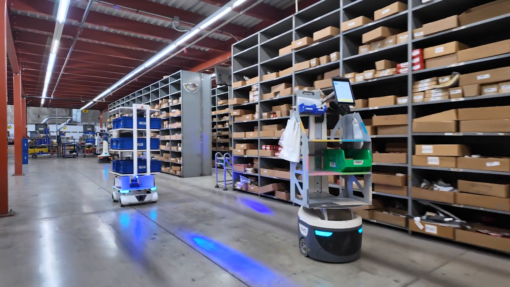
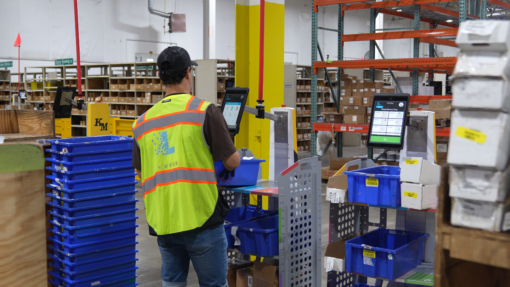
For example, System-Directed Labor (SDL) aligns humans and robots in real time and assigns tasks based on need and location without adding wearable tech or manual direction. It turns data into coordination to reduce idle time, improve accuracy, and boost throughput.
Similarly, AI-powered picking leverages computer vision to identify and retrieve products, reducing error rates and human strain while handling repetitive work.
And with AI-driven fulfillment and task orchestration, managers can make smarter staffing decisions using predictive dashboards that forecast completion times and flag bottlenecks before they happen.
Your Move:
- Start with one use case that clearly connects to ROI, like picking or labor optimization.
- Measure both operational gains and employee experience as happier workers are your early indicators of success.
- Document outcomes to build a case for scaling AI to other workflows.
Prepare Your Organization for Full Warehouse Autonomy
The goal with AI-driven warehouse automation is to remove friction from the process and let humans focus on higher tasks.
The next phase of AI in warehousing is progressive autonomy with robots and software systems that manage inventory, labor, and workflows with minimal human intervention while people oversee and optimize the strategy behind them.
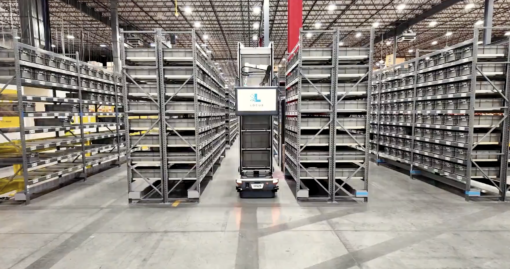
Tools like Locus Array, powered by LocusONE™, enable near–zero-touch fulfillment, reduce labor by more than 90%, and maintain productivity 24/7. But autonomy only succeeds when the operation is ready, which means that data is accurate, teams are trained, and leaders understand where AI makes the most difference.
Your Move:
- Treat AI adoption as a readiness journey and not a single investment.
- Prioritize partner selection based on trust, explainability, and proven operational expertise.
- Create a roadmap for scaling automation over time to align AI maturity with your business goals.
The Future Is Practical, Not Theoretical
AI isn’t on the horizon — it’s already in motion.
Warehouses around the world are using it to predict demand shifts, orchestrate labor, and manage multi-robot fleets with unmatched precision. The leaders who will thrive aren’t those chasing trends, but those applying AI deliberately and are grounded in data, guided by expertise, and focused on business outcomes.
Because in the warehouse, progress isn’t defined by algorithms. It’s defined by results. As the leader in AMR-powered fulfillment, Locus Robotics brings proven AI solutions to global operations.
Want to see how AI is already transforming real-world warehouse operations?
Watch the full on-demand webinar: The Practical Uses of AI in the Warehouse and then contact Locus Robotics to start building your AI roadmap today.
Author Bio:
Kait Peterson is an experienced leader in supply chain marketing currently serving as the Vice President and Head of Marketing at Locus Robotics, where she shapes the global marketing strategies, leads market intelligence, and drives go-to-market initiatives. With over a decade in supply chain technology and a background in global marketing and program management, Peterson previously led commercial integration and marketing transformation at Kaleris and Navis. Peterson also held prominent roles at Blume Global and Körber Supply Chain, overseeing global marketing and driving key strategic initiatives. Peterson holds an International MBA and has certifications in supply chain management, DEI, and marketing analytics. Beyond work, Peterson enjoys reading, outdoor activities, global travel and has a keen interest in Stoic philosophy and ancient history.


 Article