
Editor’s Note: This blog is Part 2 of a three-part series on the consumer buying shifts changing retail fulfillment. Missed Part 1? Read Beyond Black Friday: Managing the Volatility of Unpredictable Retail Demand.
Previously in this series: Part 1 showed how social discovery compresses the buying window: 59% of shoppers bought a product after discovering it on social media, and about 69% of them bought within three days. It also showed that availability outranked delivery speed, with 33% of shoppers abandoning or delaying a purchase because the exact item, size, shade, or formula was unavailable. Part 2 follows that demand to where shoppers actually buy.
Key Findings at a Glance
- 48% of U.S. apparel, beauty, and skincare shoppers used a physical store for their three most recent purchases, the most frequently reported channel in the Locus Robotics survey.
- Digital purchasing was spread across five channels: brand or retailer websites (32%), online marketplaces (31%), retailer apps (25%), resale or recommerce apps (19%), and social-media checkout (17%).
- Store replenishment and direct-to-consumer (DTC) orders create different order profiles: larger quantities and scheduled deliveries for stores, discrete picking and parcel shipment for DTC.
- Saddle Creek Logistics supports both order profiles for Psycho Bunny with Locus Origin and Locus Vector robots, reporting two to three times higher productivity.
Picture one navy crewneck sweater in a fulfillment center that serves both stores and online shoppers.
On a Monday morning, that product might appear in two different workflows. Forty store replenishment orders send multiple sizes and quantities to retail locations in consolidated shipments. At the same time, 400 consumer orders each send a sweater to an individual shopper, with every order requiring its own pick, package, shipping label, and delivery.
Same product. Different fulfillment workflows.
Physical Stores Remain the Most-Used Purchase Channel
When Locus Robotics asked 1,000 U.S. consumers where they made their three most recent apparel, beauty, and skincare purchases, the physical store came out on top.
Stores are not fading from the warehouse’s workload. Their continued importance means fulfillment operations must support store replenishment alongside orders from websites, marketplaces, apps, and social commerce.
| PURCHASE CHANNEL | SHARE OF RESPONDENTS WHO USED IT |
| Physical store | 48% |
| Brand or retailer website | 32% |
| Online marketplace | 31% |
| Retailer app | 25% |
| Resale or recommerce app | 19% |
| Social-media checkout | 17% |
Based on respondents’ three most recent apparel, beauty, or skincare purchases, so the percentages total more than 100%. Source: Locus Robotics survey of 1,000 U.S. consumers.
Now look at everything below it. Online demand does not arrive through one eCommerce channel. It arrives through five. One sweater might be ordered on the brand’s website, the next on a marketplace, a third in the retailer’s app, and a fourth through a social checkout. Every one of those orders lands at the same pick location.
And the shoppers creating that mix are not choosing between digital and physical. They are using both, often for the same purchase.
Younger Shoppers Use Both Screens and Stores
That pattern is clearest among Gen Z. Deloitte found that 64% of Gen Z consumers use social media to research products and 35% use it to discover products. Yet 73% still shop in person at least once a week.
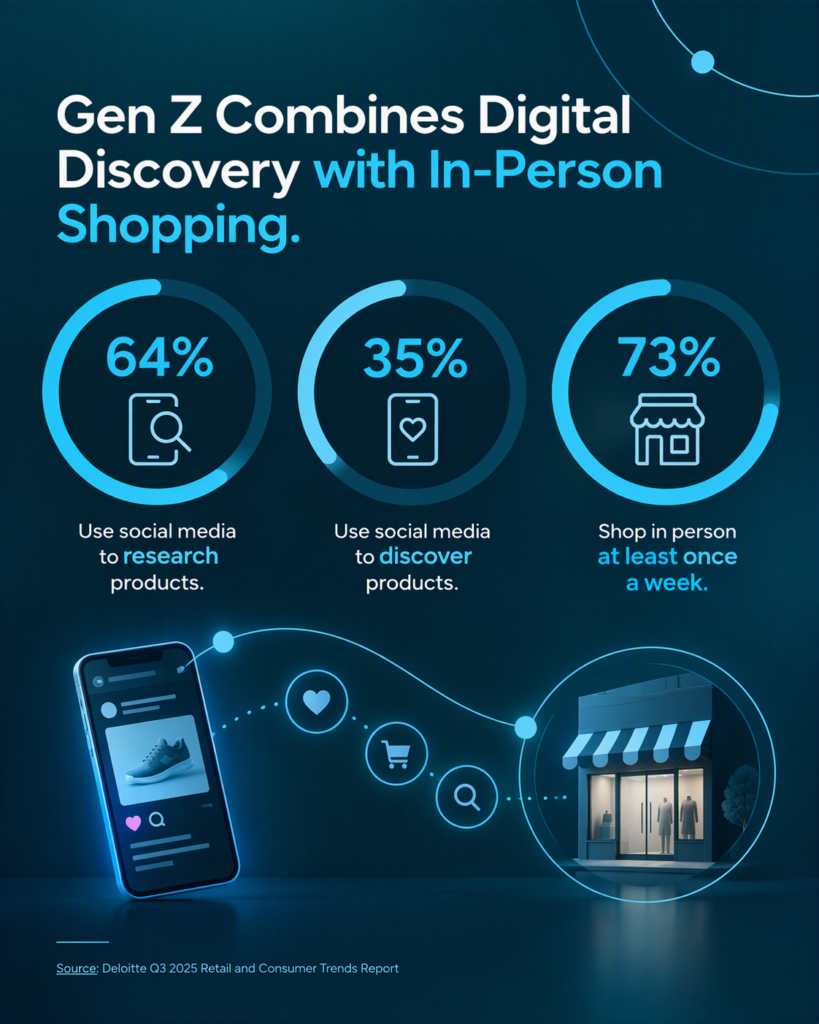
In apparel and beauty, that behavior makes sense. Fit, shade, and fragrance are hard to judge through a screen. So, the shopper who first sees our sweater in a social video might try it on in a store that weekend, then order a second color in the app that night.
Every stop on that journey draws on the same pool of inventory.
How Store Replenishment and DTC Fulfillment Create Different Warehouse Work
Serving every stop on that journey from shared inventory is what omnichannel fulfillment means in practice. It also means supporting very different kinds of orders. As our report notes, store replenishment and product drops may involve larger quantities and scheduled deliveries, while direct-to-consumer orders require discrete picking and parcel shipment.
For the sweater, store replenishment may involve multiple sizes and quantities consolidated into scheduled shipments for dozens of locations. DTC fulfillment breaks demand into hundreds of individual orders, each requiring discrete picking, packing, labeling, and parcel shipment.
In a steady week, a well-run operation can manage both. The trouble starts when both peak at the same time.
What Happens When Both Orders Spike in the Same Week
Suppose the sweater’s retail product drop is scheduled for the same week it takes off on social media. As Part 1 showed, social demand can turn into orders within days.
Now three things are competing for the same building.
- People. The product drop needs associates preparing larger-quantity orders for scheduled store deliveries. The social spike needs associates picking discrete orders for parcel shipment. Someone has to decide which work gets released first, and if labor cannot shift between workflows quickly, one of them misses its deadline.
- Inventory. Both orders pull from the same sweaters. If the forward pick location for a popular size runs empty while units are committed to the store order, the website can show that size as unavailable even though the building still holds it. That is the exact problem Part 1 identified: shoppers walk away when the specific size or variant they want is not available.
- Infrastructure. Fixed warehouse automation can perform effectively when channels and order profiles remain consistent. Nothing about the sweater’s week is consistent.
That makes the sweater’s week a useful test for any automation investment.
Questions to Ask When Evaluating Automation for Store and DTC Fulfillment
Run the sweater’s week through these six questions:
- Coverage: Can the same automation support consolidated store replenishment orders and discrete DTC orders within the same operation?
- Reallocation: When digital demand spikes, how quickly can resources shift between store replenishment and discrete DTC picking?
- Inventory direction: Can inventory be directed to where demand is developing before the pick location runs empty?
- Scalability: Can capacity increase for the spike without permanent infrastructure or facility redesign?
- Store roles: As stores take on new discovery, pickup, fulfillment, or returns roles, can the system adapt?
- Integration: Does the system integrate with your existing WMS and ERP systems? Interact Analysis found integration complexity was the leading barrier to automation adoption.
Saddle Creek Logistics has had to answer these questions in practice.
Proof in Practice: Saddle Creek Logistics and Psycho Bunny
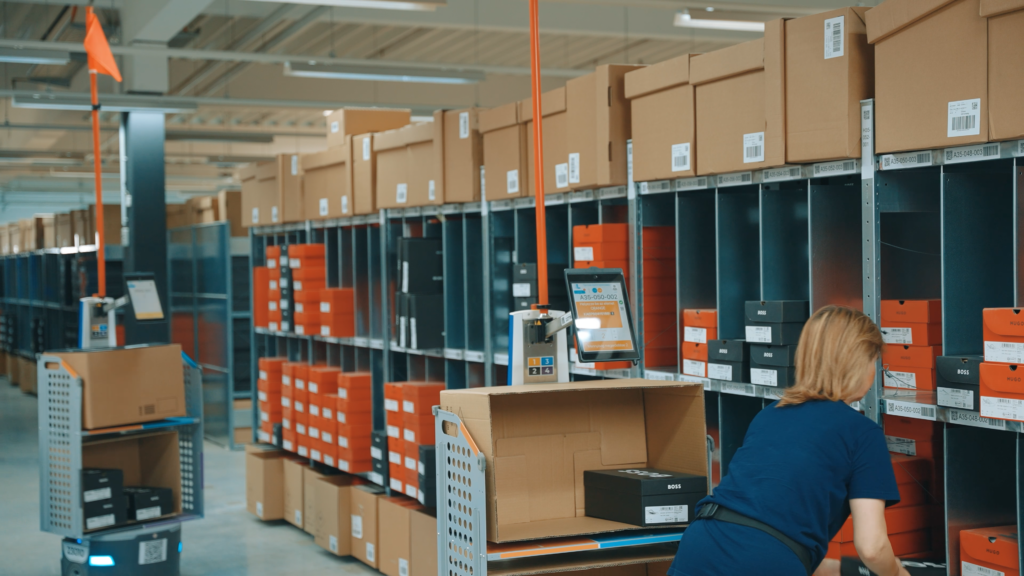
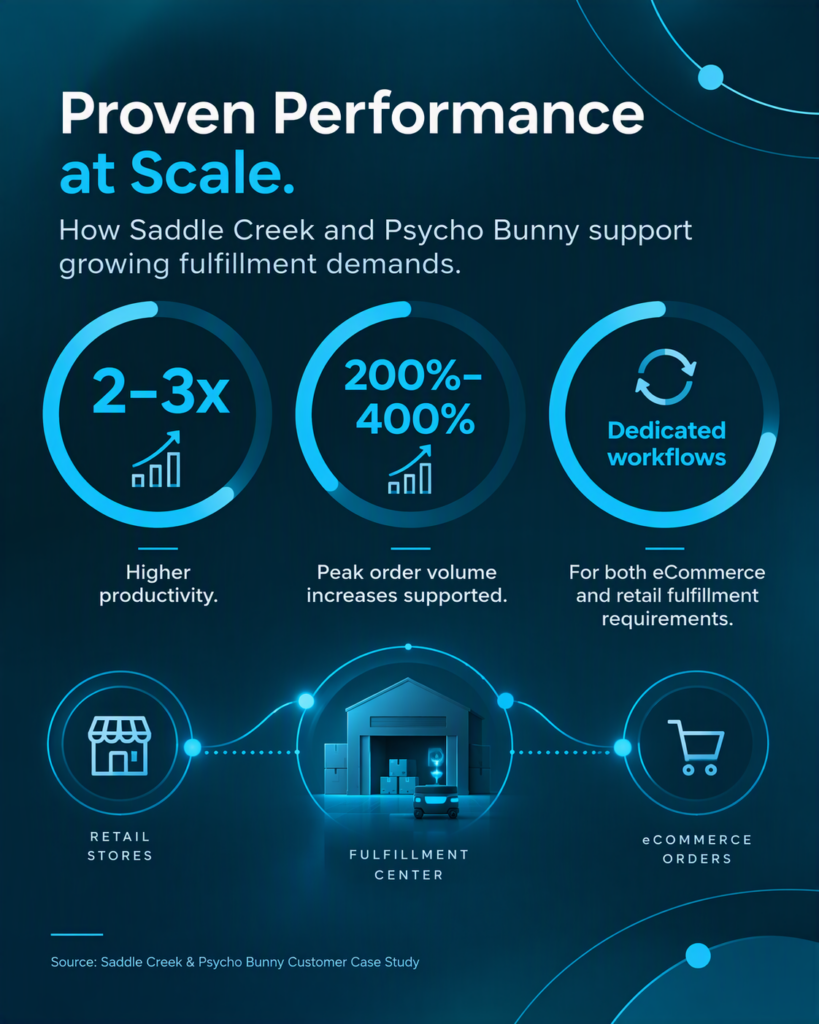
Saddle Creek Logistics supports store replenishment, retail product drops, and direct-to-consumer orders for Psycho Bunny within the same fulfillment environment.
Instead of forcing both order profiles through one workflow, the operation matches each to a different robot type:
- Locus Origin robots support eCommerce order processing and discrete picking.
- Locus Vector robots support larger-quantity retail orders, including store replenishment and product drops.
Both are powered by LocusONE, which integrates with WMS and ERP systems and coordinates robots, associates, tasks, priorities, and workflows in real time. The results show:
- Two to three times higher productivity
- Support for peak order-volume increases of 200% to 400%
Store and Online Orders, Served from the Same Inventory
Physical stores remain central to how consumers shop, and five digital channels sit alongside them. The fulfillment operations that keep pace will be the ones that can serve both from the same inventory, and shift between them as demand moves.
Some of those sweaters will also come back. A shopper who ordered two sizes to compare fit at home will return one, and that unit has to be received, inspected, and restored to sellable inventory before it can fill the next order. In Part 3, we examine this behavior, known as apparel bracketing, and what it means for reverse logistics.
Get the Complete Research
Download the full report to explore all four consumer buying shifts changing retail fulfillment and warehouse automation decisions.
Read the full report: From Viral Demand to Intentional Returns.