
Physical AI in Warehouse Fulfillment
Physical AI is the application of artificial intelligence to real-world physical environments. In warehouse fulfillment, it enables systems to perceive conditions, make decisions, coordinate workflows, and execute work directly within the operation — connecting intelligence to movement, manipulation, and execution rather than stopping at analysis.
At a Glance
- The Core Definition
- Physical AI represents the convergence of artificial intelligence, robotics, computer vision, sensing, orchestration, and autonomous execution.
- The Operational Differentiator
- Traditional automation relies on rigid, static rules. Physical AI continuously adapts to shifting warehouse variability, labor fluctuations, and SKU growth in real time.
- The Business Impact
- Physical AI is trusted by more than 150 brands across 360+ global sites, delivering productivity improvements of up to 300% and order accuracy approaching 99.9%.
Warehouse Operations No Longer Run Under Predictable Conditions
Variability has always been part of warehouse operations. What has changed is how often it occurs and how quickly conditions can shift. Order profiles shift throughout the day. Labor availability changes from shift to shift. SKU counts continue to grow. Customer expectations continue to compress fulfillment timelines.
The challenge is no longer simply moving more orders through the building. It is maintaining performance when demand, labor, inventory, and workflow priorities rarely stay the same for long. This reality is driving growing interest in Physical AI: intelligent systems that can perceive, decide, coordinate, and act inside live warehouse environments.
Unlike software-only AI that stops at recommendations or analysis, Physical AI connects intelligence directly to execution. It allows automation systems to respond to operational variability as work unfolds rather than relying on static rules, fixed workflows, or predetermined paths.
What Is Physical AI? The Definition of Intelligence in Motion
Physical AI is the application of artificial intelligence to real-world physical environments.
In warehouse fulfillment, Physical AI enables systems to perceive conditions, make decisions, coordinate workflows, and execute work directly within the operation. Rather than simply analyzing data or generating recommendations, Physical AI connects intelligence to movement, manipulation, and execution. This allows automation systems to respond dynamically as inventory, demand, labor availability, and operational priorities evolve.
Physical AI vs. Traditional Warehouse Automation
Physical AI represents the convergence of artificial intelligence, robotics, computer vision, sensing, orchestration, and autonomous execution. It differs fundamentally from static rules-based automation.
| Operational Feature | Traditional Automation | Locus Robotics Physical AI |
|---|---|---|
| Environmental Control |
Requires highly controlled, predictable areas.
|
Purpose-built for dynamic, fluid brownfield layouts.
|
| Workflow Logic |
Follows predefined paths and rigid, static sequences.
|
Continuously perceives conditions and re-prioritizes work.
|
| System Scope |
Restricted to isolated software tasks or simple transport.
|
Unifies perception, routing, orchestration, and grasping.
|
| Disruption Recovery |
Demands manual operator intervention when plans change.
|
Orchestrates real-time routing to eliminate localized bottlenecks.
|
| Resource Allocation |
Relies on static planning cycles and workflow assumptions.
|
Balances people, robots, inventory, and task priority in real time.
|
A software system may identify congestion developing in a pick zone. A Physical AI system can recognize the congestion, determine its impact on the operation, coordinate a response, and physically execute the work needed to reduce the bottleneck. Mobile robots are often part of a Physical AI system, but movement alone does not create autonomous fulfillment.
How Physical AI Works in Warehouse Fulfillment
Physical AI connects intelligence to warehouse execution through four core capabilities.
The Four Capabilities of Physical AI
1. Perceive
Continuously monitor warehouse conditions across inventory, workflow status, robot activity, associate activity, congestion, exceptions, and fulfillment priorities.
2. Decide
Prioritize work and direct resources based on demand, inventory location, workflow dependencies, available resources, and real-time constraints.
3. Orchestrate
Coordinate robots, associates, workflows, task sequencing, inventory movement, traffic flow, and throughput balancing across the facility.
4. Act
Execute work directly through collaborative fulfillment, autonomous transport, robotic manipulation, grasping, in-aisle fulfillment, and other physical activities.
These capabilities allow automation systems to respond to what is happening in the warehouse instead of relying on fixed assumptions about how work should flow.
Why Warehouse Leaders Are Turning to Physical AI
Warehouse performance is rarely determined by a single workflow. A gain in one area can create pressure somewhere else. Faster picking can overwhelm pack operations. Additional labor in one zone can create congestion in another. Work rarely moves through a warehouse one workflow at a time.
Physical AI helps align work across multiple workflows at the same time. Instead of optimizing individual tasks in isolation, it focuses on how work moves through the operation as a whole. Warehouses are no longer judged solely by how efficiently they operate under ideal conditions — they are judged by how well they continue executing when conditions change.
What Physical AI Helps Improve
Physical AI influences more than a single workflow. Its impact is often seen in how work moves across the operation as a whole. Warehouses typically see the biggest impact in a few key areas:
Most warehouses cannot pause operations and redesign facilities around a single automation model — a core reason flexibility-first automation matters.
How Locus Robotics Delivers Physical AI
Physical AI depends on more than intelligent robots. It requires a system capable of coordinating work across people, robots, inventory, and workflows as conditions change throughout the day. Locus Robotics brings Physical AI into warehouse fulfillment through a combination of orchestration, autonomous movement, collaborative execution, mobile manipulation, and Robots-to-Goods automation.
LocusONE®: The Orchestration Layer
LocusONE® serves as the orchestration layer that coordinates robots, associates, workflows, inventory availability, task sequencing, traffic management, and fulfillment priorities across the warehouse. As conditions change, LocusONE® continuously rebalances work to help maintain operational flow.
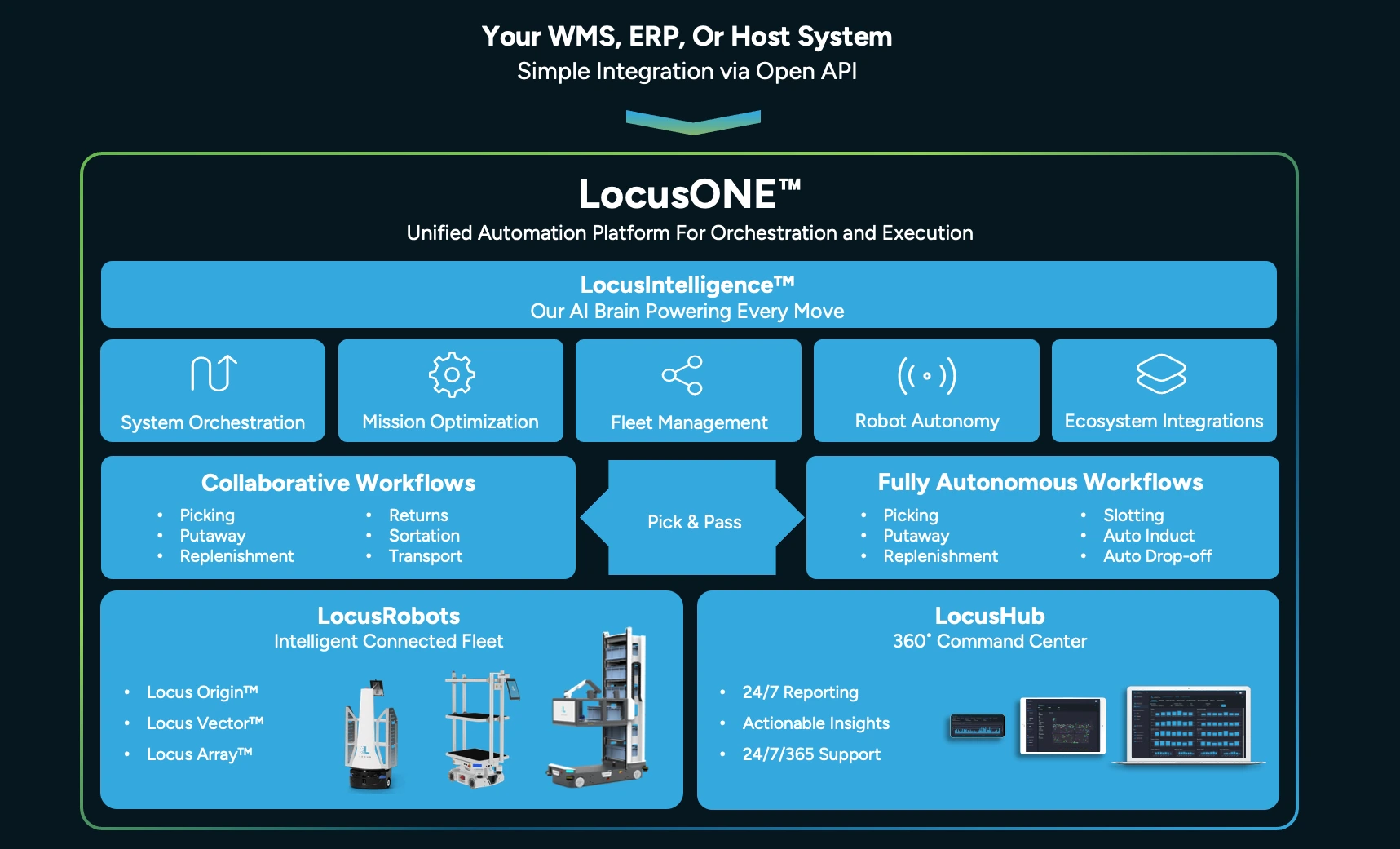
Locus Origin: Collaborative Fulfillment Execution
Many fulfillment workflows still depend on people. Locus Origin helps reduce travel time by directing associates to the right work at the right time. Associates remain focused on picking while orchestration continuously balances workload across the operation. This collaborative model helps maintain picking flow while reducing one of the largest sources of wasted time inside the warehouse: walking.
Locus Vector: Autonomous Transport and Material Movement
Inventory movement connects nearly every warehouse workflow. Locus Vector automates transport activities between receiving, storage, picking, replenishment, pack, and outbound operations — moving inventory more consistently while freeing associates to focus on higher-value work.
Locus Array: Mobile Manipulation and Robots-to-Goods Execution
Locus Array extends Physical AI directly into the aisle. As a fully autonomous Robots-to-Goods system, Array combines AI-powered vision, real-time decision-making, patented robotic grasping, and autonomous mobility to execute fulfillment tasks directly where inventory resides. Array can pick, putaway, induct, drop-off, and slot inventory within active warehouse environments.
Why Orchestration Is the Differentiator
Warehouse execution is rarely limited by a single workflow. Picking, transport, replenishment, pack, outbound staging, inventory movement, and exception handling all influence one another throughout the day. Physical AI only works when systems can recognize what is happening across the operation and respond accordingly.
In practice, warehouse orchestration continuously evaluates factors such as:
- order demand
- task priority
- resource availability
- congestion
- downstream capacity
Those decisions do not happen once at the start of a shift — they are constantly reevaluated as work moves through the operation. Faster task execution has limited value if congestion, bottlenecks, or recovery work continues spreading elsewhere. Orchestration keeps workflows aligned, so gains in one area do not create pressure somewhere else.
Mobile Manipulation Extends Physical AI Into Fulfillment Execution
Physical AI depends on the ability to interact with the physical world. Understanding what is happening across the operation is only part of the equation — systems must also be able to perform work within it. Mobile manipulation combines autonomous mobility, computer vision, robotic grasping, and real-time decision-making to allow robots to move through warehouse environments and interact directly with inventory.
Moving inventory through the warehouse is relatively straightforward compared to identifying, selecting, grasping, and handling individual items consistently at production scale. Items vary in size, shape, weight, packaging, material, and presentation. Mobile manipulation allows autonomous systems to identify, grasp, transport, and place inventory despite that variation — extending Physical AI beyond coordination and transportation into fulfillment execution itself.
Robots-to-Goods and Autonomous Fulfillment
Robots-to-Goods (R2G) is a warehouse automation model pioneered by Locus Robotics in which robots travel directly to inventory and execute fulfillment tasks where the inventory resides. By keeping inventory stationary and bringing automation to the work, R2G enables fulfillment activities to take place within the flow of warehouse operations.
Locus Array applies the Robots-to-Goods model by bringing automation directly to inventory locations throughout the facility. Rather than transporting inventory to a person or fixed automation system, Array performs fulfillment tasks where inventory resides — supporting autonomous execution while preserving existing storage infrastructure and warehouse layouts.
Physical AI in Existing Warehouse Environments
Most warehouse automation deployments happen in brownfield environments. Facilities are already operating, inventory is already flowing, and associates are already executing established workflows. There is rarely an opportunity to pause fulfillment operations and redesign the warehouse from the ground up.
Any new automation system must coexist with existing storage systems, established processes, and legacy technology while continuing to support daily operations. Physical AI gives organizations a way to expand automation capabilities while preserving flexibility for future operational changes.
Proven in Real Warehouse Operations
Physical AI is already operating inside warehouse environments today. Warehouse fulfillment provides one of the most demanding environments for intelligent systems — labor availability fluctuates, inventory moves constantly, and priorities get reordered throughout the day. In real-world deployments, warehouses have reported:
- productivity improvements ranging from 50% to 300%
- order accuracy levels approaching 99.9%
- training time reductions of 50% to 90%
- throughput increases of 25% or more while operating within existing facilities
These outcomes appear across retail distribution, healthcare fulfillment, industrial operations, and third-party logistics. Trusted by more than 150 brands across more than 350 sites worldwide, Locus Robotics supports fulfillment operations ranging from first-time automation deployments to large-scale enterprise networks.
Related ContentContinue Exploring
Frequently Asked Questions
Get Started
Ready to See Physical AI in Motion?
See how Locus Robotics combines orchestration, mobile manipulation, Robots-to-Goods automation, and adaptive fulfillment to help operations maintain performance as conditions evolve.