
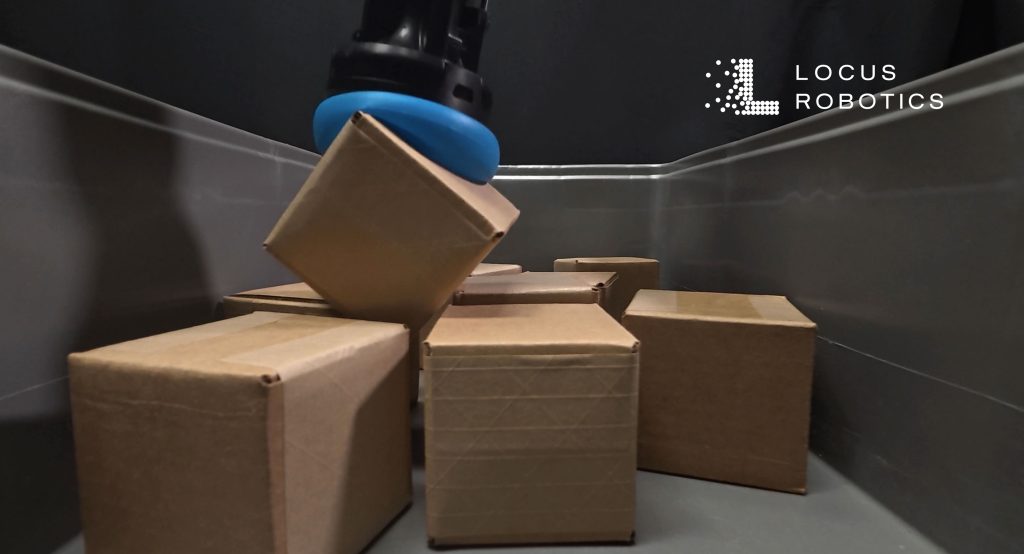
Robotic grasping is the hardest problem in warehouse automation because handling unpredictable, deformable, and constantly changing items requires perception, judgment, and adaptation that humans perform instinctively and machines must compute in real time.
A human picker can reach into a tote of loosely packed polybags, adjust their grasp instinctively, and pull the right item in less than a second. For a robotic system, that same action is significantly more complex than it looks.
The package flexes unexpectedly. The item shifts during contact. Reflective surfaces interfere with perception, while thin plastic catches at the wrong camera angle. Soft goods collapse under pressure, and irregular packaging changes how the item needs to be handled from one pick to the next.
This is why robotic grasping remains one of the grand challenges of robotics within warehouse automation. Movement can be mapped. Routes can be optimized. Workflows can be orchestrated. But autonomous fulfillment only scales when robots can reliably interact with the real, inconsistent inventory moving through warehouse operations every day.
That is the problem mobile manipulation needs to solve.
What Is Robotic Grasping in Warehouse Automation?
Robotic grasping is the ability for a robot to identify, grasp, lift, and move inventory autonomously inside a warehouse environment. In practice, that involves much more than simply touching an item and lifting it off a shelf or moving between storage totes.
The system has to recognize what it is handling, determine how to approach it, apply the correct amount of force, maintain control during movement, and complete the action reliably at production speed. It also has to repeat that process across millions of different SKUs with varying shapes, materials, surfaces, and packaging conditions.
That complexity becomes much harder inside live fulfillment operations. Warehouse robots are not interacting with perfectly staged objects inside controlled lab environments. They are operating around shifting inventory, crowded totes, damaged cartons, changing lighting conditions, inconsistent packaging, and constantly moving workflows.
The result is a level of physical variability that continues to challenge the most advanced robotic systems, let alone be deployed at scale.
Read how Locus Robotics’ acquisition of Nexera Robotics advances mobile manipulation for Locus Array.

Why Real-World Inventory is So Difficult to Grasp
Anyone who has worked inside a fulfillment operation knows inventory rarely behaves the same way twice. A supplier changes packaging without warning. Polybags cling together during humid shifts. Labels wrinkle. Cases collapse during replenishment. An item arrives overstuffed into a tote, while another shifts during transport and settles into an entirely different position than expected.
Humans compensate for those conditions instinctively, often without even realizing they are doing it. Robots historically have struggled to make those same adjustments reliably under changing warehouse conditions, particularly at enterprise scale where systems need to execute reliably across millions of picks and constantly changing inventory conditions. Researchers describe these conditions as “unstructured environments.” Operators just call it Tuesday.
The challenge is not simply that warehouses carry millions of SKUs. It is that the characteristics of those SKUs continue changing constantly. So, a grasp that worked yesterday no longer works reliably today. Robots have to recognize what they’re handling, adjust in real time, and do it without slowing the operation down and that is where many systems still struggle.
Learn about Locus Array: AI-driven mobile manipulation for production-scale fulfillment.

Why Suction-Based Picking Falls Short
For years, robotic picking systems relied almost exclusively on suction-based end-effectors. In tightly controlled environments with rigid packaging and highly consistent inventory, suction can work effectively and reliably. However, modern warehouse fulfillment operations rarely stay that predictable for long.
Suction-based systems often depend on stable contact and predictable surfaces. But fulfillment inventory changes constantly. Packaging shifts slightly. Materials flex differently from shipment to shipment. Small variations in orientation or surface condition can interrupt the pick entirely.
At enterprise scale, those interruptions matter. A robot that succeeds most of the time still creates a large volume of exceptions if picks fail repeatedly across thousands of orders per hour. This “long-tail” problem, where achieving high success over ever-increasing SKU variability, is the crux of the robotic grasping challenge. A relatively small number of unsuccessful picks, even fractions of a percent, can scale to a significant cost for warehouse operators to manage.
The robot may successfully reach the item but still fail to complete the pick consistently. At enterprise scale, those failed picks create manual exceptions that operators still need to recover, slowing throughput and interrupting workflow continuity across the operation.
Autonomous fulfillment depends on consistency, not isolated success cases inside controlled conditions.
Why Mobile Manipulation Matters Now
A warehouse is anything but predictable. Volumes can spike suddenly, order profiles change along with SKU variability, ultimately forcing operations to adjust continuously just to maintain throughput targets.
Labor instability alone has become a major operational constraint. In fact, U.S. industry estimates showed more than 370,000 warehouse jobs sitting unfilled, while annual warehouse turnover rates remained near 50%.
That reality is the driving force behind pushing warehouse automation beyond movement alone. Mobility gets the robot to the work, but manipulation allows the robot to perform the work—that’s the game changer. Mobile manipulation allows autonomous systems to interact directly with inventory rather than simply transporting it through the facility.
Physical AI systems that perceive changing conditions, respond in real time, and adapt physically as inventory, workflows, and operating conditions shift throughout the day is shaping the next phase of autonomous fulfillment.
How End Effectors Change the Grasping Equation
At Locus Robotics, we recognized the scale of the problem, and it’s what led us to develop Locus Array. But here’s the thing — we knew that it was never just about autonomous movement through the warehouse. It’s always been about what the robot could do once it moved to where the work happens.
The new patented end-effector technology was designed specifically for the SKU variability common in fulfillment operations, including porous textiles, loosely bagged items, perforated polybags, irregular packaging, delicate products, and inconsistent surfaces.
Instead of depending entirely on suction and airtight seals, the patented end-effector uses a patented membrane technology designed to conform more effectively to varying item characteristics. The system combines computer vision, onboard sensing, and adaptive grasping intelligence to help robots respond to changing inventory conditions in real time.
The objective is to help autonomous systems handle a broader range of real warehouse inventory reliably, even as packaging, surfaces, and item conditions continue changing throughout the operation.

What Better Grasping Means for Autonomous Fulfillment
Better grasping does more than improve an individual pick. It expands the share of fulfillment work that can be automated, reduces manual exception handling, and allows autonomous systems to operate more reliably inside real warehouse conditions.
Movement made warehouse robots useful. Orchestration made robotic fleets more intelligent. Grasping is what allows autonomous systems to engage directly with inventory itself. It is the shift from moving work to doing the work.
For the broader vision behind fully autonomous fulfillment, read CEO Rick Faulk’s companion piece on mobile manipulation at enterprise scale.