
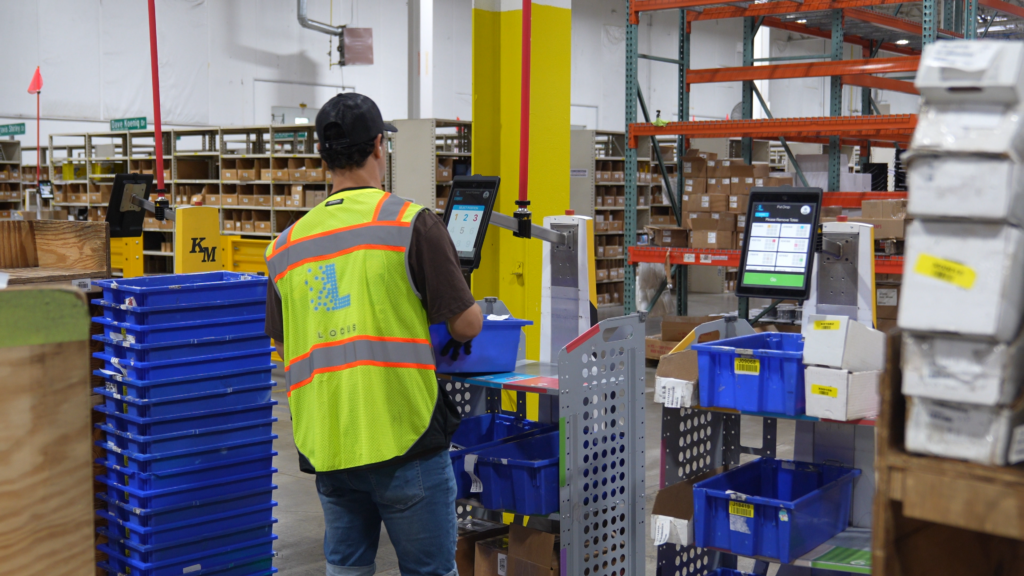
Warehouse automation is no longer a choice between manual operations and robotics. Today’s fulfillment leaders must decide which automation architecture can best support changing demand, labor availability, SKU complexity, and growth requirements.
Understanding Warehouse Fulfillment Models
Goods-to-Person (G2P), Person-to-Goods (P2G), and Robots-to-Goods (R2G) describe different approaches to moving work, workers, and inventory throughout a warehouse. While the goal of each model is to improve productivity, accuracy, and operational efficiency, they differ in how fulfillment tasks are executed and how automation is applied.
In a Goods-to-Person workflow, inventory is brought to a worker. In a Person-to-Goods workflow, workers travel to inventory locations to complete tasks such as picking, replenishment, or putaway. In a Robots-to-Goods workflow, autonomous robots travel to inventory locations and perform tasks such as picking, putaway, replenishment, or transport directly at the point of storage.
It is also important to distinguish fulfillment models from enabling technologies. AS/RS (Automated Storage and Retrieval Systems) and AMRs (Autonomous Mobile Robots) are not fulfillment models themselves. Rather, they are technologies that can support different warehouse workflows. For example, AS/RS technologies are commonly used to enable Goods-to-Person operations, while AMRs are frequently used in Person-to-Goods workflows to help coordinate movement and transport materials throughout the facility.
Comparing Warehouse Fulfillment Models
While all three fulfillment models are designed to improve warehouse efficiency, they differ in how work is executed, the role workers and automation play, infrastructure requirements, and long-term operational flexibility. The comparison below highlights some of the key considerations warehouse leaders evaluate when assessing automation strategies.
|
Evaluation Area |
AS/RS-Enabled Goods-to-Person |
AMR-Assisted Person-to-Goods |
Robots-to-Goods |
|
What it is |
A fulfillment approach where automated storage and retrieval technology brings inventory to a worker at a station. |
A fulfillment approach where associates travel to inventory locations, with AMRs helping guide work, reduce travel, and transport materials. |
A fulfillment approach where autonomous robots travel to inventory locations and perform work such as picking, putaway, replenishment, or transport. |
|
What moves through the warehouse |
Inventory moves from storage to a workstation or goods-to-person station. |
Workers move to inventory, often with AMRs supporting task direction and material movement. |
Robots move to inventory and execute work at the inventory location. |
|
Role of the worker |
Workers typically remain stationed at work areas where inventory is presented to them. |
Workers remain central to task execution, with robots helping coordinate movement and workflow. |
Workers are less directly involved in repetitive execution, though they may still support oversight, exceptions, replenishment, and process control. |
|
Infrastructure commitment |
Typically requires significant fixed infrastructure, system engineering, and facility integration. |
Typically lower infrastructure commitment; often designed to operate within existing facilities. |
Can often operate within existing racking and layouts, subject to aisle, storage, item, and workflow requirements. |
|
Brownfield compatibility |
May be more complex in existing facilities depending on building constraints, layout, disruption tolerance, and integration requirements. |
Often well suited to brownfield environments because workflows can usually be introduced around existing layouts and processes. |
Potentially well suited to brownfield environments where the physical layout, storage profile, and workflows can support robotic execution at the inventory location. |
|
Storage-density potential |
Often strong when the operation prioritizes dense storage and highly engineered inventory presentation. |
Generally depends on the existing storage layout; the model improves workflow execution more than storage density. |
Depends on storage configuration, robot capabilities, item accessibility, and workflow design. |
|
SKU and item-handling requirements |
Best suited to inventory profiles that fit the storage and retrieval system’s handling requirements. |
Can support a broad range of SKUs when associates handle item variability directly. |
Fit depends on item dimensions, packaging, pickability, storage method, and the tasks the robotic system is designed to perform. |
|
Exception-handling model |
Exceptions may require defined resolution processes around the fixed system, workstation flow, or upstream/downstream integration. |
Workers can often resolve exceptions directly because they remain close to inventory and task execution. |
Exception handling depends on the level of autonomy, software orchestration, human support model, and workflow design. |
|
Integration complexity |
Often higher due to fixed automation, controls, WMS/WES integration, and facility engineering. |
Typically more incremental, though success still depends on integration, training, process design, and workflow coordination. |
Depends on the degree of robotic autonomy, task execution requirements, connected systems, and operational orchestration. |
|
Scalability mechanism |
Scale is often achieved by expanding or modifying system infrastructure, workstations, storage capacity, or related automation. |
Scale is often achieved by adding robots, expanding workflows, and coordinating labor and robot capacity. |
Scale is often achieved by adding robotic capacity and extending software-orchestrated execution across more workflows or operating zones. |
|
Adaptability to change |
Strong in stable, predictable environments; changes may require system reconfiguration or additional engineering. |
Flexible across many existing warehouse workflows, especially where labor remains part of execution. |
Designed to sustain throughput across more variable operating conditions, depending on workflow, item, and facility requirements. |
|
Best-suited operating environment |
Operations with predictable workflows, stable inventory profiles, high storage-density needs, and long-term infrastructure plans. |
Operations that need faster deployment, incremental automation, and flexibility within existing facilities. |
Operations seeking more autonomous execution across workflows where robots can operate effectively at the inventory location. |
|
Primary tradeoff |
Higher infrastructure commitment and less flexibility once the system is engineered around specific assumptions. |
Continued reliance on labor availability and process consistency, even with robotic assistance. |
Greater autonomy potential, but fit depends on operational conditions, item characteristics, workflow design, and system integration. |
What These Comparisons Mean for Live Warehouse Operations
Comparison tables are useful for understanding the differences between fulfillment models, but selecting the right approach requires evaluating how those differences align with operational realities. Factors such as facility constraints, SKU variability, labor availability, exception handling, and growth plans often have as much impact on success as throughput targets or automation architecture.
Brownfield vs. Greenfield Deployment
A warehouse designed around automation has different requirements than an existing facility that must continue operating during deployment. In many cases, the decision is less about which fulfillment model delivers the highest theoretical performance and more about which approach can be implemented with the least operational disruption while supporting long-term business goals.
SKU and Inventory Variability
Not all operations handle the same products. Item dimensions, packaging types, storage methods, and order profiles can influence which fulfillment model is the best fit. Systems optimized for a highly predictable inventory profile may face different challenges than operations managing frequent product changes or a wide range of SKU characteristics.
Exception Handling Still Matters
Every warehouse experiences damaged inventory, inventory discrepancies, replenishment delays, and other operational exceptions. Evaluating how work is redirected, escalated, or recovered when processes do not go as planned is often just as important as evaluating standard workflow performance.
The Role of Labor Continues to Evolve
Automation changes how work is performed, but workers remain an important part of most warehouse operations. Depending on the fulfillment model, labor may focus on picking, replenishment, oversight, exception management, inventory control, or other operational activities.
The Importance of Orchestration
Many warehouses use multiple automation technologies across different workflows. The challenge is ensuring those systems work together as part of a coordinated operation rather than creating isolated automation islands. As facilities become more automated, software orchestration plays an increasingly important role in balancing work, prioritizing tasks, and maintaining operational flow.
When Each Fulfillment Model Makes Sense
Goods-to-Person (G2P)
Goods-to-Person workflows are often a strong fit for operations with high-volume, repeatable processes that can benefit from bringing inventory directly to workers. Organizations frequently evaluate this approach when they prioritize storage density, consistent workflows, and long-term infrastructure investments.
Best suited for:
- Predictable order profiles
- Structured workflows
- High-volume fulfillment
- Long-term facility planning
Person-to-Goods (P2G)
Person-to-Goods workflows are often selected when organizations want to increase productivity while maintaining flexibility within existing facilities. AMR-assisted workflows can help reduce travel time, improve task coordination, and support incremental automation adoption.
Best suited for:
- Existing warehouse environments
- Fast deployment timelines
- Incremental automation strategies
- Operations that benefit from human flexibility
Robots-to-Goods (R2G)
Robots-to-Goods are a strong fit for operations seeking greater autonomous execution directly at the inventory location. The model is designed to support workflows such as picking, putaway, replenishment, and transport while maintaining flexibility as operational requirements evolve.
Best suited for:
- Changing demand patterns
- Complex fulfillment operations
- Multi-workflow environments
- Organizations pursuing greater autonomy over time
What Matters Beyond Throughput
Throughput is an important performance metric, but it should not be the sole factor driving an automation decision. The most effective fulfillment strategy is often the one that aligns with an operation’s inventory profile, labor model, facility constraints, growth plans, and long-term business objectives.
The most effective automation strategy is rarely defined by a single performance metric. Instead, organizations must balance operational requirements, growth plans, workforce considerations, and facility constraints when evaluating long-term automation investments.
How Locus Robotics Supports Multiple Fulfillment Models
Locus Robotics supports multiple fulfillment models through a unified platform that helps warehouses deploy and coordinate automation across the operation.
- Locus Origin for AMR-assisted Person-to-Goods workflows, including picking, replenishment, and transport
- Locus Vector for high-throughput transport and material movement across warehouse operations
- Locus Array for Robots-to-Goods fulfillment workflows that enable autonomous execution at the inventory location
- LocusONE™ for orchestration across robots, workflows, and warehouse systems
Find the Right Fulfillment Strategy for Your Operation
Every warehouse has unique requirements. Explore how Locus Robotics helps organizations evaluate, deploy, and orchestrate fulfillment solutions that align with operational goals today while providing flexibility for future growth.