


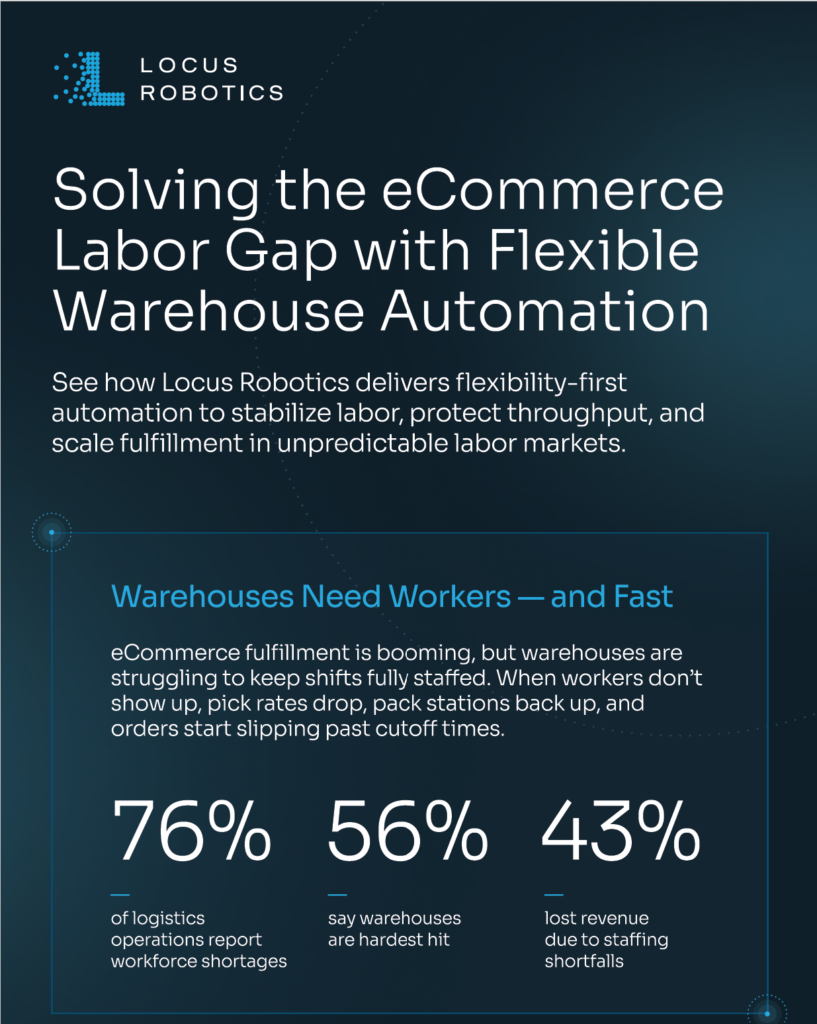
What happens when labor shortages, rising order volume, and operational pressure collide on the warehouse floor.
eCommerce demand keeps accelerating, but warehouse labor availability isn’t keeping pace. As staffing shortages continue across fulfillment operations, warehouse leaders are under pressure to maintain throughput, hit SLAs, and keep orders moving — even when shifts aren’t fully staffed.
This infographic explores how flexibility-first warehouse automation helps operations stabilize labor, reduce operational strain, and maintain fulfillment performance in unpredictable labor markets. From collaborative Person-to-Goods (P2G) robotics to fully autonomous Robots-to-Goods (R2G) systems, modern fulfillment operations are shifting toward adaptive automation built to absorb variability without slowing down.
Inside the infographic:
- Key labor shortage statistics impacting warehouse operations
- Why fulfillment work has become harder to staff and sustain
- How AMRs help reduce travel time and operational bottlenecks
- The role orchestration platforms like LocusONE™ play in maintaining flow
- How flexible automation helps warehouses scale without disruptive redesigns
The warehouses performing best today aren’t waiting for labor conditions to stabilize. They’re building operations designed to perform through uncertainty.

 Case Study